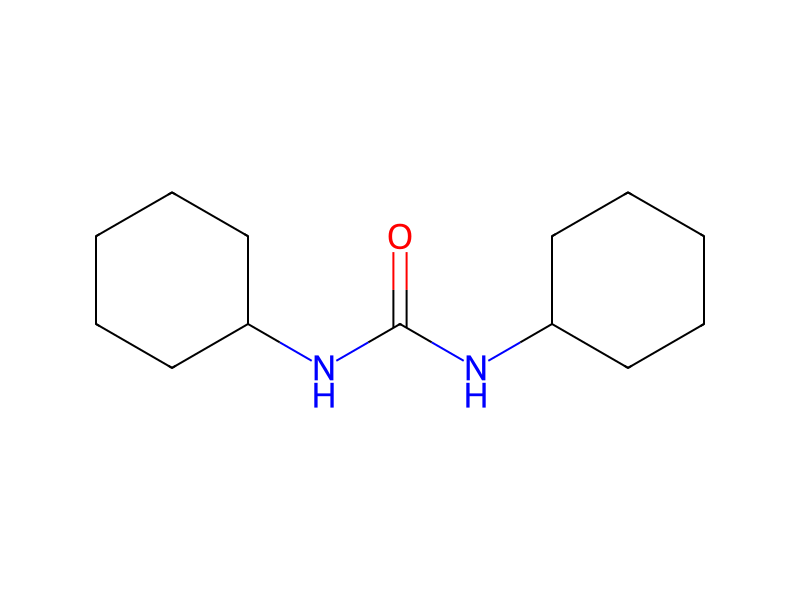
Dicyclohexylcarbodiimide → N,N'-Dicyclohexylurea
HRID 1763223
Reaction equation

C(O)[C@@H](O)C(O)=[O:4].NC=CC1C=CC=CC=1.[CH:17]1([N:23]=[C:24]=[N:25][CH:26]2[CH2:31][CH2:30][CH2:29][CH2:28][CH2:27]2)[CH2:22][CH2:21][CH2:20][CH2:19][CH2:18]1>C(#N)C>[CH:26]1([NH:25][C:24]([NH:23][CH:17]2[CH2:18][CH2:19][CH2:20][CH2:21][CH2:22]2)=[O:4])[CH2:31][CH2:30][CH2:29][CH2:28][CH2:27]1Participants
5
Reactant 3



Product 1
Reagents, catalysts & solvents 1

Procedure
To a solution (cooled to 0° C) of 5.3 g (0.05 mole) D-glyceric acid in 150 ml of acetonitrile, there was added 8.9 g (0,075 mole) β - aminostyrene and 10.3 g (0.05 mole) N.N' - dicyclohexylcarbodiimide. A precipitate of N.N' - dicyclohexylurea is formed immediately, but the reaction was allowed to proceed for 15 hours at room temperature. After filtration and removal of the acetonitrile by distillation under reduced pressure, the residue was taken up in ethyl acetate and extracted with HCl, bicarbonate and water. After drying and removal of the solvent the residue was crystallized from chloroform, yielding 7.5 g (73%), m.p. 135°-136° C.