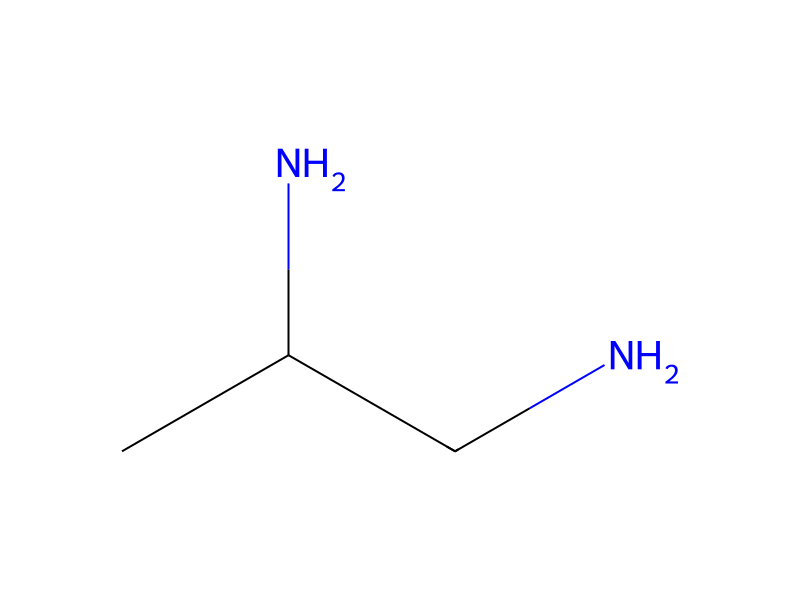
Propylenediamine → 5,6-Bis(4-fluorophenyl)-2-methyl-2,3-dihydropyrazine
HRID 1774091
Reaction equation

[F:1][C:2]1[CH:7]=[CH:6][C:5]([C:8]([C:10]([C:12]2[CH:17]=[CH:16][C:15]([F:18])=[CH:14][CH:13]=2)=O)=O)=[CH:4][CH:3]=1.[NH2:19][CH2:20][CH:21]([NH2:23])[CH3:22]>C(O)C>[F:1][C:2]1[CH:7]=[CH:6][C:5]([C:8]2[C:10]([C:12]3[CH:17]=[CH:16][C:15]([F:18])=[CH:14][CH:13]=3)=[N:23][CH:21]([CH3:22])[CH2:20][N:19]=2)=[CH:4][CH:3]=1Participants
4
Reactant 2

Product 1

Reagents, catalysts & solvents 1

Procedure
First, with ethanol as a solvent, 5.31 g of 4,4′-difluorobenzil (by Tokyo Chemical Industry Co., Ltd.) and 1.60 g of 1,2-diaminopropane (by Kanto Chemical Co., Inc.) are mixed. Subsequently, the mixed solution is refluxed for three hours. Then, after the refluxed solution is condensed by using an evaporator and treated with ethanol and then recrystallized, 2,3-bis(4-fluorophenyl)-5-methyl-5,6-dihydropyrazine is obtained (light yellow powder, yield: 86%).