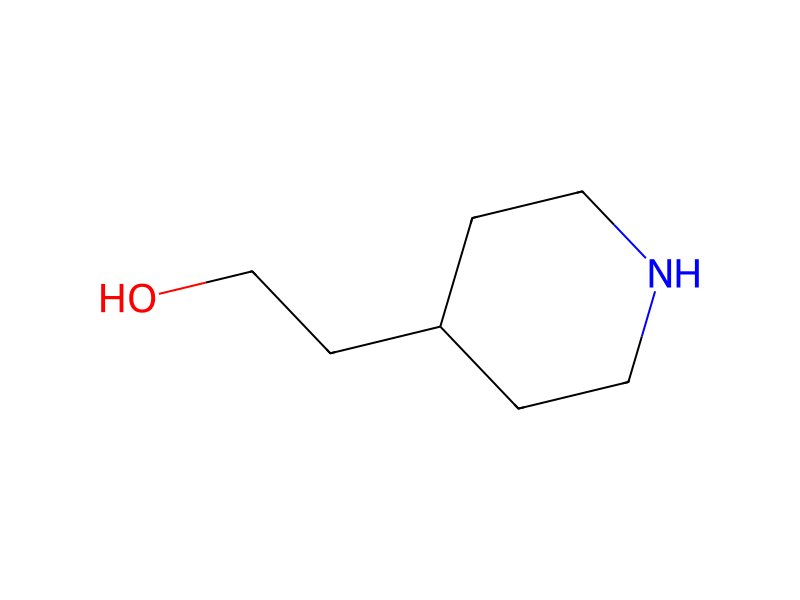
4-Piperidineethanol → 1-[(2-Phenylquinazolin-4-yl)-carbonyl]piperidine-4-ethanol
HRID 1788740
Reaction equation

[C:1]1([C:7]2[N:16]=[C:15]([C:17]([O:19]CC)=O)[C:14]3[C:9](=[CH:10][CH:11]=[CH:12][CH:13]=3)[N:8]=2)[CH:6]=[CH:5][CH:4]=[CH:3][CH:2]=1.[NH:22]1[CH2:27][CH2:26][CH:25]([CH2:28][CH2:29][OH:30])[CH2:24][CH2:23]1>O>[C:1]1([C:7]2[N:16]=[C:15]([C:17]([N:22]3[CH2:27][CH2:26][CH:25]([CH2:28][CH2:29][OH:30])[CH2:24][CH2:23]3)=[O:19])[C:14]3[C:9](=[CH:10][CH:11]=[CH:12][CH:13]=3)[N:8]=2)[CH:2]=[CH:3][CH:4]=[CH:5][CH:6]=1Participants
4
Reactant 2

Product 1

Reagents, catalysts & solvents 1

Procedure
Ethyl 2-phenylquinazoline-4-carboxylate (1.7 g) and piperidine-4-ethanol (8 g) are heated at 150° C. for 4 hours. After cooling, water is added and the mixture is extracted with ethyl acetate. The organic phase is dried over magnesium sulphate and evaporated to dryness under reduced pressure. The residue is chromatographed on silica gel with ethyl acetate as the eluant, and the product recovered is recrystallised from isopropyl ether. This gives 1-[(2-phenylquinazoline-4-yl)carbonyl]-piperidine-4-ethanol (0.5 g), melting at 146° C.