HomeMCPWorkbenchSkills
HomeWorkbenchNotificationsMe
llms.txt · MCP GuidePrivacy Policy · Terms of Service · Supportv1.8.3
  1. Home
  2. /Reaction

3-(3-Nitro-phenyl)-acrylonitrile → 3-(3-Nitro-phenyl)-propionitrile

HRID 1837516
Print

Reaction equation

HRID 1837516 reaction equation
[N+:1]([C:4]1[CH:5]=[C:6]([CH:10]=[CH:11][C:12]#[N:13])[CH:7]=[CH:8][CH:9]=1)([O-:3])=[O:2]>C1C=CC(P(C2C=CC=CC=2)C2C=CC=CC=2)=CC=1.C1C=CC(P(C2C=CC=CC=2)C2C=CC=CC=2)=CC=1.C1C=CC(P(C2C=CC=CC=2)C2C=CC=CC=2)=CC=1.[Cl-].[Rh].C1C=CC=CC=1>[N+:1]([C:4]1[CH:5]=[C:6]([CH2:10][CH2:11][C:12]#[N:13])[CH:7]=[CH:8][CH:9]=1)([O-:3])=[O:2]
ParticipantsConditionsProcedureWorkupSources & evidenceReaction notes

Participants

4

Reactant 1

HCID 556693-(3-Nitro-phenyl)-acrylonitrile

Product 1

HCID 221860983-(3-Nitro-phenyl)-propionitrile

Reagents, catalysts & solvents 2

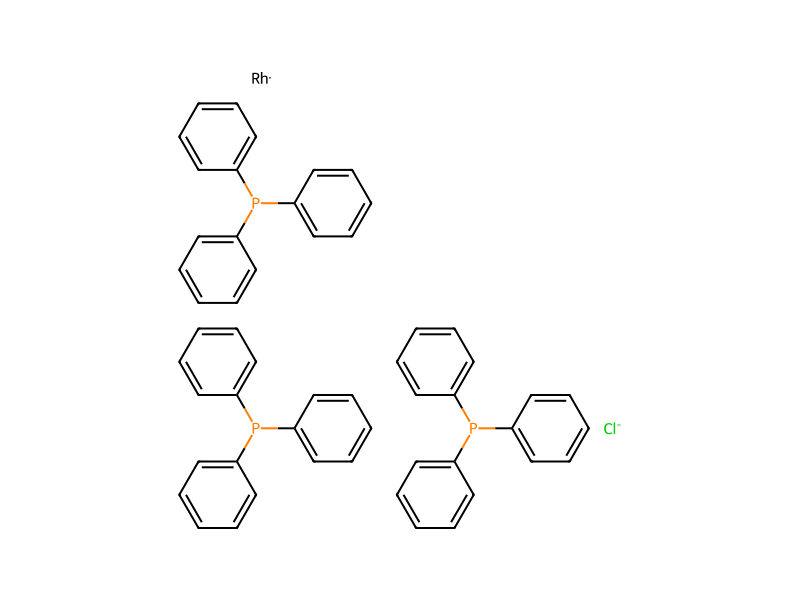
HCID 84599Chlorotris(triphenylphosphine)rhodium(I)CatalystHCID 241BenzeneSolvent

Conditions

Temperature
40 °C

Procedure

There are introduced into a cylinder 3 g of the product obtained in Step 1, 1.59 g of tris(triphenylphosphine)rhodium(I) chloride and 90 ml of benzene. The whole is heated for 5 hours at 40° C. under a hydrogen pressure of 5 bar. The solvent is evaporated off and the residue is purified by chromatography on silica gel using dichloromethane as eluant.

Workup

  1. customThe solvent is evaporated off
  2. customthe residue is purified by chromatography on silica gel

Sources & evidence

ORD record
ord-85e8aacf647b40d99e6441bc79a44ef9
Source dataset
uspto-grants-2004_08
DOI
10.6084/m9.figshare.5104873.v1
Patent number
US06784183B2

Reaction notes

On this pageParticipantsConditionsProcedureWorkupSources & evidenceReaction notes