1,8-Diaminonaphthalene → 2-(3-Bromophenyl)-2,3-dihydro-1H-naphtho[1,8-de]-1,3,2-diazaborine
Reaction equation

[Br:1][C:2]1[CH:3]=[C:4]([B:8](O)O)[CH:5]=[CH:6][CH:7]=1.[C:11]1([NH2:22])[C:20]2[C:15](=[CH:16][CH:17]=[CH:18][C:19]=2[NH2:21])[CH:14]=[CH:13][CH:12]=1>C1(C)C=CC=CC=1>[Br:1][C:2]1[CH:3]=[C:4]([B:8]2[NH:22][C:11]3[C:20]4[C:15]([CH:14]=[CH:13][CH:12]=3)=[CH:16][CH:17]=[CH:18][C:19]=4[NH:21]2)[CH:5]=[CH:6][CH:7]=1Participants
4
Reactant 2


Product 1
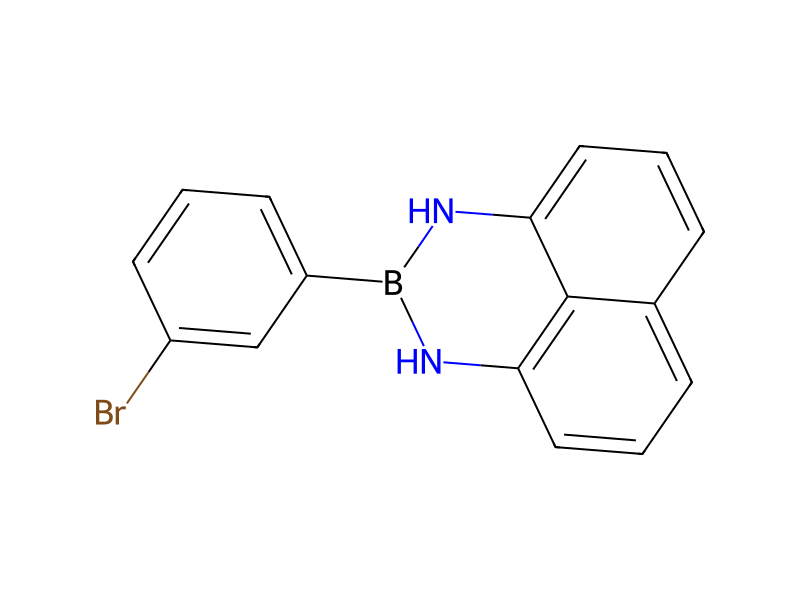
Reagents, catalysts & solvents 1

Procedure
A solution of 3-bromobenzene boronic acid (20 g, 0.1 mol) and naphthalene-1,8-diamine (17.3 g, 0.11 mol) in anhydrous toluene (600 mL) was heated to reflux for 16 hours. The reaction mixture was cooled to room temperature, then concentrated in vacuo. The residue was purified by silica gel column chromatography eluting with petroleum ether:EtOAc 5:1 to afford the title compound as a grey solid in 54% yield, 23 g.
Workup
- temperatureto reflux for 16 hours
- concentrationconcentrated in vacuo
- customThe residue was purified by silica gel column chromatography
- washeluting with petroleum ether:EtOAc 5:1
Sources & evidence
- ORD record
- ord-562e58f8917f4ef58c890f9fa3461faf
- Source dataset
- uspto-grants-2015_02
- Patent number
- US08952008B2
Reaction notes
Loading…