2,4-Dichloroaniline → 5-Pyrimidinecarboxylic acid, 2-[(2,4-dichlorophenyl)amino]-4-(trifluoromethyl)-, methyl ester
Reaction equation

Cl[C:2]1[N:7]=[C:6]([C:8]([F:11])([F:10])[F:9])[C:5]([C:12]([O:14][CH3:15])=[O:13])=[CH:4][N:3]=1.[Cl:16][C:17]1[CH:23]=[C:22]([Cl:24])[CH:21]=[CH:20][C:18]=1[NH2:19]>O1CCOCC1>[Cl:16][C:17]1[CH:23]=[C:22]([Cl:24])[CH:21]=[CH:20][C:18]=1[NH:19][C:2]1[N:7]=[C:6]([C:8]([F:11])([F:10])[F:9])[C:5]([C:12]([O:14][CH3:15])=[O:13])=[CH:4][N:3]=1Participants
4



Procedure
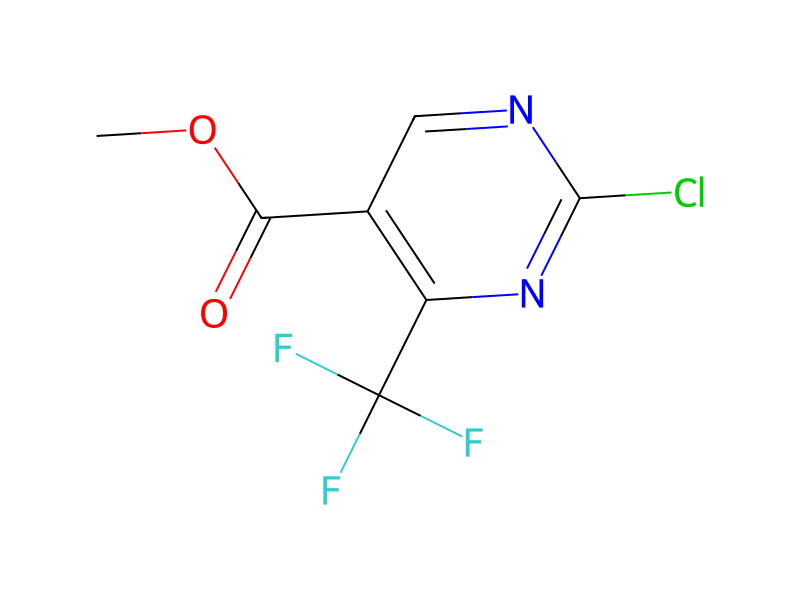
To a solution of methyl 2-chloro-4-trifluoromethylpyrimidine-5-carboxylate (70 g, ex Maybridge 22 g, ex Fluorochem 48 g) in 1,4-dioxan (100 n−1) was added 2,4-dichloroaniline (142 g) and the solution stirred under reflux for 10.5 h. 1,4-Dioxan was partially removed (approx 50 ml) under reduced pressure and 2N HCl (800 ml) added. The mixture was stirred with overhead stirring for 3 h and the resulting solid filtered onto a sinter. The solid was washed with 2N HCl (2×300 ml) and water (4×400 ml) then dried over sodium hydroxide in vacuo at 50° C. to afford methyl 2-(2,4-dichlorophenylamino)-4-trifluoromethyl-pyrimidine-5-carboxylate. The solid contained approximately 5% 2,4-dichloroaniline.