HomeMCPWorkbenchSkills
HomeWorkbenchNotificationsMe
llms.txt · MCP GuidePrivacy Policy · Terms of Service · Supportv1.8.3
  1. Home
  2. /Reaction

Ethanol → 1-(2-Fluorophenyl)-2-methoxynaphthalene

HRID 1912165
Print

Reaction equation

HRID 1912165 reaction equation
Br[C:2]1[C:11]2[C:6](=[CH:7][CH:8]=[CH:9][CH:10]=2)[CH:5]=[CH:4][C:3]=1[O:12][CH3:13].[F:14][C:15]1[CH:20]=[CH:19][CH:18]=[CH:17][C:16]=1B(O)O.C(O)C.C(=O)([O-])[O-].[Na+].[Na+]>C1(C)C=CC=CC=1.C1C=CC([P]([Pd]([P](C2C=CC=CC=2)(C2C=CC=CC=2)C2C=CC=CC=2)([P](C2C=CC=CC=2)(C2C=CC=CC=2)C2C=CC=CC=2)[P](C2C=CC=CC=2)(C2C=CC=CC=2)C2C=CC=CC=2)(C2C=CC=CC=2)C2C=CC=CC=2)=CC=1>[F:14][C:15]1[CH:20]=[CH:19][CH:18]=[CH:17][C:16]=1[C:2]1[C:11]2[C:6](=[CH:7][CH:8]=[CH:9][CH:10]=2)[CH:5]=[CH:4][C:3]=1[O:12][CH3:13]
ParticipantsProcedureWorkupSources & evidenceReaction notes

Participants

7

Reactant 4

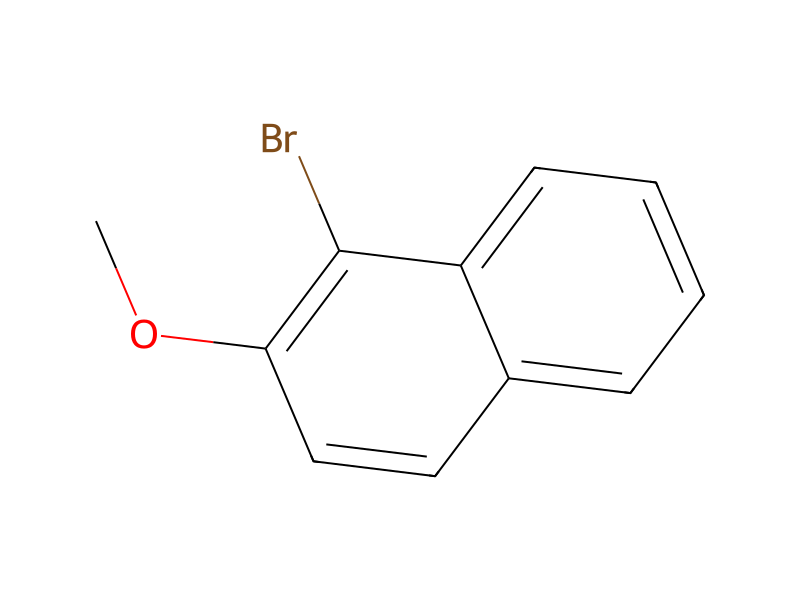
HCID 702EthanolHCID 10340Sodium CarbonateHCID 728601-Bromo-2-methoxynaphthaleneHCID 27343542-Fluorophenylboronic acid

Product 1

HCID 679806421-(2-Fluorophenyl)-2-methoxynaphthaleneYield 60%

Reagents, catalysts & solvents 2

HCID 178418397
HCID 178418397, compound
Catalyst
HCID 1140TolueneSolvent2×

Procedure

Into a 500 mL three-neck flask were placed 8.7 g (35 mmol) of 1-bromo-2-methoxynaphthalene, and 5.0 g (35 mmol) of 2-fluorophenylboronic acid. The air in the flask was replaced with nitrogen. To this mixture were added 120 mL of toluene, 60 mL of ethanol, and 40 mL of an aqueous solution of sodium carbonate (2.0 mol/L). While the pressure was reduced; this mixture was stirred to be degassed. To this mixture was added 2.0 g (1.7 mmol) of tetrakis(triphenylphosphine)palladium(0), and the mixture was stirred at 80° C. for 8 hours under a nitrogen stream. The aqueous layer of the obtained mixture was subjected to extraction with toluene, and the obtained solution of the extract and the organic layer were combined and washed with saturated brine. The organic layer was dried over magnesium sulfate, and this mixture was gravity-filtered. An oily substance obtained by concentration of the obtained filtrate was dissolved in about 30 mL of toluene. This solution was suction-filtered through Celite (produced by Wako Pure Chemical Industries, Ltd., Catalog No. 531-16855), alumina, and Florisil (produced by Wako Pure Chemical Industries, Ltd., Catalog No. 540-00135). An oily substance obtained by concentration of the obtained filtrate was dried under reduced pressure, so that 5.3 g of a pale yellow oily substance of the object of the synthesis was obtained in 60% yield. The above-described synthesis scheme is illustrated in the following scheme (C-1).


Workup

  1. customInto a 500 mL three-neck flask were placed
  2. customto be degassed
  3. stirringthe mixture was stirred at 80° C. for 8 hours under a nitrogen stream
  4. extractionThe aqueous layer of the obtained mixture was subjected to extraction with toluene
  5. extractionthe obtained solution of the extract
  6. washwashed with saturated brine
  7. dry with materialThe organic layer was dried over magnesium sulfate
  8. filtrationthis mixture was gravity-filtered
  9. customAn oily substance obtained by concentration of the obtained filtrate
  10. filtrationThis solution was suction-filtered through Celite (produced by Wako Pure Chemical Industries, Ltd., Catalog No. 531-16855), alumina, and Florisil (produced by Wako Pure Chemical Industries, Ltd., Catalog No. 540-00135)
  11. customAn oily substance obtained by concentration of the obtained filtrate
  12. customwas dried under reduced pressure, so that 5.3 g of a pale yellow oily substance of the object of the synthesis
  13. customwas obtained in 60% yield
  14. customThe above-described synthesis scheme

Sources & evidence

ORD record
ord-c1ef30d96b924dfbb75c1e238de2fa12
Source dataset
uspto-grants-2013_12
DOI
10.6084/m9.figshare.5104873.v1
Patent number
US08604224B2

Reaction notes

On this pageParticipantsProcedureWorkupSources & evidenceReaction notes