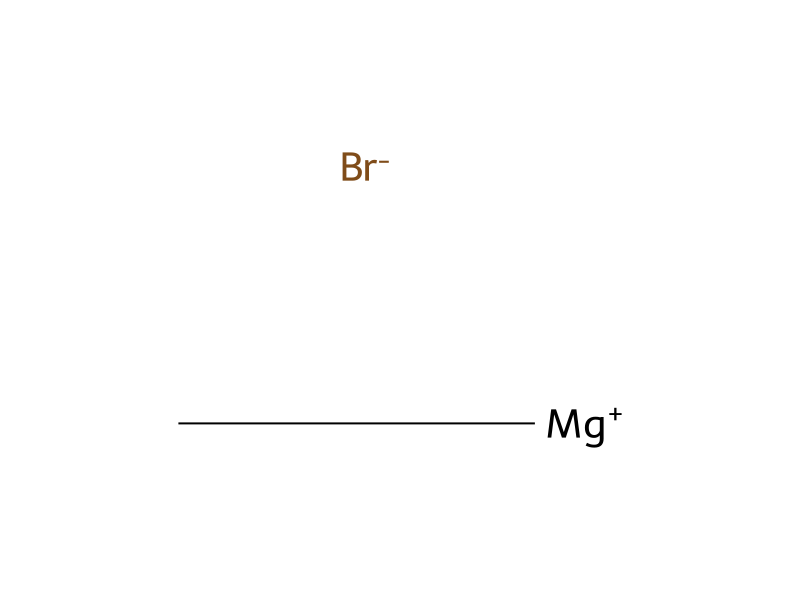
[CH3:1][Mg+].[Br-].[Br:4][C:5]1[CH:10]=[CH:9][C:8]([N:11]2[CH:15]=[C:14](C(OCC)=O)[N:13]=[C:12]2[C:21]([C:24]2[CH:29]=[CH:28][CH:27]=[CH:26][C:25]=2[F:30])([CH3:23])[CH3:22])=[CH:7][CH:6]=1.ClCCl.CC[O:36][CH2:37][CH3:38]>>[Br:4][C:5]1[CH:10]=[CH:9][C:8]([N:11]2[CH:15]=[C:14]([C:37]([OH:36])([CH3:38])[CH3:1])[N:13]=[C:12]2[C:21]([C:24]2[CH:29]=[CH:28][CH:27]=[CH:26][C:25]=2[F:30])([CH3:23])[CH3:22])=[CH:7][CH:6]=1To a 250 mL round bottom flask, purged with dry N2 and attached with addition funnel, was added a 3.0M MeMgBr (12 mL, 3.7 equiv) solution in Et2O. The flask was cooled to 0° C. prior to dropwise addition of ethyl 1-(4-bromophenyl)-2-(2-(2-fluorophenyl)propan-2-yl)-1H-imidazole-4-carboxylate (4.22 g, 9.78 mmol) in a solution of anhydrous dichloromethane (80 mL). The reaction solution was allowed to stir, warming to room temperature over 1 hr. The reaction solution was quenched by addition of aq NH4Cl. The mixture was poured to a reparatory funnel and the dichloromethane layer was partitioned, dried over Na2SO4, filtered, concentrated and chromatographed through a 40 g SiO2 column using a gradient of 100% Hx to 70% EtOAc to yield the title compound (3.19 g, 78% yield). LCMS (ES): m/z=417.3, 419.3 [M+H]+.