Acetyl chloride → HCID 66985921, compound
Reaction equation

C([Cl:4])(=O)C.[NH2:5][C:6]1[CH:11]=[CH:10][CH:9]=[CH:8][C:7]=1[C:12]1[N:16]([CH2:17][CH:18]([CH3:20])[CH3:19])[C:15]([CH2:21][CH2:22][CH2:23][CH3:24])=[N:14][C:13]=1[C:25]#[N:26]>C(O)C>[ClH:4].[CH2:21]([C:15]1[N:16]([CH2:17][CH:18]([CH3:20])[CH3:19])[C:12]2[C:7]3[CH:8]=[CH:9][CH:10]=[CH:11][C:6]=3[N:5]=[C:25]([NH2:26])[C:13]=2[N:14]=1)[CH2:22][CH2:23][CH3:24]Participants
4
Reactant 2

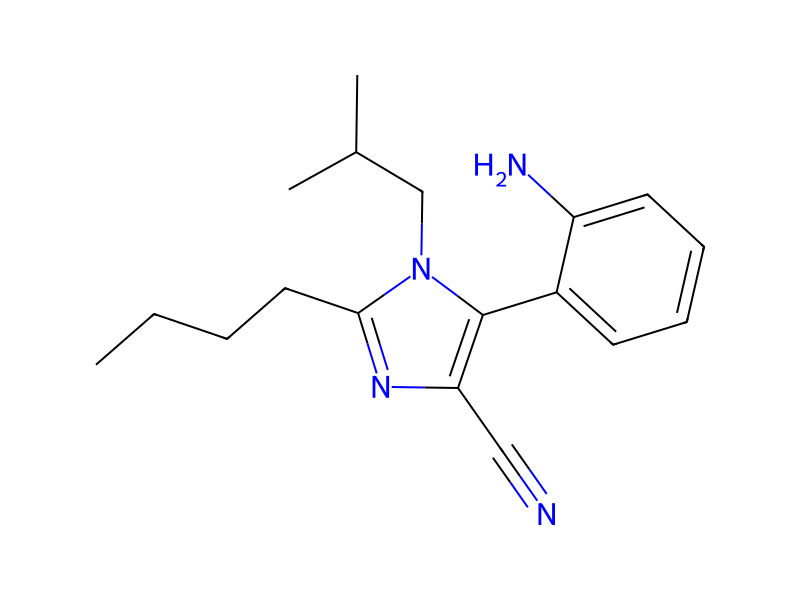
Product 1

Reagents, catalysts & solvents 1

Procedure
Under a nitrogen atmosphere, a solution of acetyl chloride (412 mg, 5.25 mmol) in anhydrous ethanol (17.5 mL) was stirred for 15 minutes. 5-(2-Aminophenyl)-2-butyl-1-(2-methylpropyl)-1H-imidazole-4-carbonitrile (1.04 g, 3.50 mmol) was added, and the reaction was heated at reflux under nitrogen for 21.5 hours, allowed to cool to room temperature overnight, and further cooled on an ice bath. A solid was present and was isolated by filtration, washed with diethyl ether, and air-dried to provide 1.04 g (89%) of 2-butyl-1-(2-methylpropyl)-1H-imidazo[4,5-c]quinolin-4-amine hydrochloride.