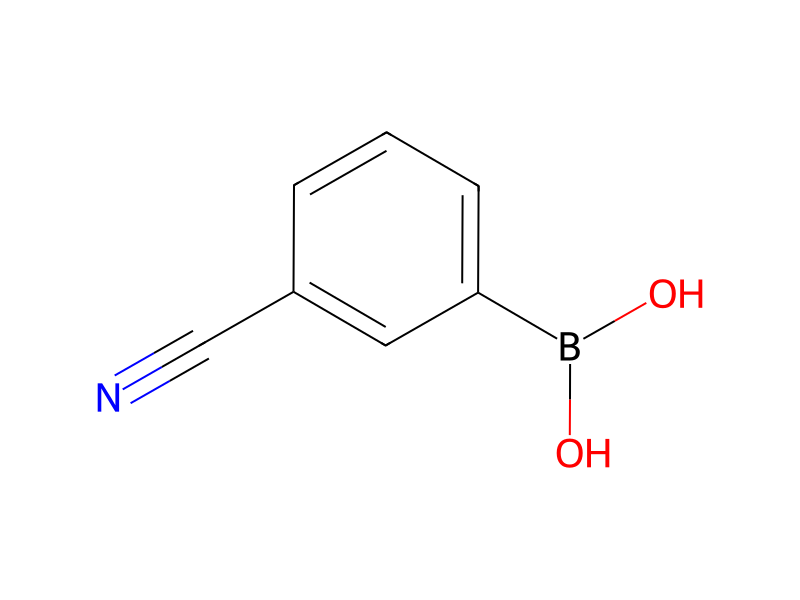
Br[C:2]1[CH:3]=[C:4]([CH2:10][CH3:11])[C:5](=[O:9])[NH:6][C:7]=1[CH3:8].[C:12]([C:14]1[CH:15]=[C:16](B(O)O)[CH:17]=[CH:18][CH:19]=1)#[N:13].C(=O)([O-])[O-].[Na+].[Na+]>C1(P(C2C=CC=CC=2)C2C=CC=CC=2)C=CC=CC=1.C1(P(C2C=CC=CC=2)C2C=CC=CC=2)C=CC=CC=1.C1(P(C2C=CC=CC=2)C2C=CC=CC=2)C=CC=CC=1.C1(P(C2C=CC=CC=2)C2C=CC=CC=2)C=CC=CC=1.[Pd].C1(C)C=CC=CC=1>[CH2:10]([C:4]1[C:5](=[O:9])[NH:6][C:7]([CH3:8])=[C:2]([C:18]2[CH:19]=[C:14]([CH:15]=[CH:16][CH:17]=2)[C:12]#[N:13])[CH:3]=1)[CH3:11]A stirred mixture of 5-bromo-3-ethyl-6-methyl-1H-pyridin-2-one, prepared in accordance with the procedures of PREPARATION 1, Step 2, (100 mg, 0.46 mmol), 3-cyanophenylboronic acid (88 mg, 0.6 mmol), 2M aq sodium carbonate (0.69 mL, 1.38 mmol), palladium tetrakis(triphenylphosphine) (16 mg, 0.014 mmol) and toluene (5 mL) is heated at reflux under a nitrogen atmosphere. After 2 hr, more catalyst (16 mg) is added and heating is continued overnight. The reaction is cooled and the mixture is partitioned between water and dichloromethane. The organic layer is separated and the solvents are removed. The residue is purified by chromatography eluting with ethyl acetate and with dichloromethane-5% methanol. Fractions containing product are combined, concentrated and the residue is triturated with hot ether to afford 3-(5-ethyl-2-methyl-6-oxo-1,6-dihydropyridin-3-yl)benzonitrile (40 mg, 36%) as a white solid. LC/MS: MS m/e=239 (M+H); RT 2.83 min.
Loading…