HomeMCPWorkbenchSkills
HomeWorkbenchNotificationsMe
llms.txt · MCP GuidePrivacy Policy · Terms of Service · Supportv1.8.3
  1. Home
  2. /Reaction

Carbon Tetrachloride → 1,1',1''-(Chlorosilylidyne)tris(benzene)

HRID 1940362
Print

Reaction equation

HRID 1940362 reaction equation
[Cr:1]([O:24][Si:25]([C:38]1[CH:43]=[CH:42][CH:41]=[CH:40][CH:39]=1)([C:32]1[CH:37]=[CH:36][CH:35]=[CH:34][CH:33]=1)[C:26]1[CH:31]=[CH:30][CH:29]=[CH:28][CH:27]=1)([O:4][Si:5]([C:18]1[CH:23]=[CH:22][CH:21]=[CH:20][CH:19]=1)([C:12]1[CH:17]=[CH:16][CH:15]=[CH:14][CH:13]=1)[C:6]1[CH:11]=[CH:10][CH:9]=[CH:8][CH:7]=1)(=[O:3])=[O:2].C=C.C1([Si](C2C=CC=CC=2)(C2C=CC=CC=2)O)C=CC=CC=1.[O-2].[O-2].[O-2].[Cr+6].C1([Si](O[Si](C2C=CC=CC=2)(C2C=CC=CC=2)C2C=CC=CC=2)(C2C=CC=CC=2)C2C=CC=CC=2)C=CC=CC=1.C(Cl)(Cl)(Cl)[Cl:110]>C(O)(=O)C.C(#N)C.C(C#N)CC>[C:6]1([Si:5]([C:18]2[CH:23]=[CH:22][CH:21]=[CH:20][CH:19]=2)([C:12]2[CH:17]=[CH:16][CH:15]=[CH:14][CH:13]=2)[Cl:110])[CH:11]=[CH:10][CH:9]=[CH:8][CH:7]=1.[Cr:1]([O:24][Si:25]([C:32]1[CH:37]=[CH:36][CH:35]=[CH:34][CH:33]=1)([C:38]1[CH:39]=[CH:40][CH:41]=[CH:42][CH:43]=1)[C:26]1[CH:27]=[CH:28][CH:29]=[CH:30][CH:31]=1)([O:4][Si:5]([C:12]1[CH:17]=[CH:16][CH:15]=[CH:14][CH:13]=1)([C:18]1[CH:23]=[CH:22][CH:21]=[CH:20][CH:19]=1)[C:6]1[CH:7]=[CH:8][CH:9]=[CH:10][CH:11]=1)(=[O:3])=[O:2]

ParticipantsProcedureWorkupSources & evidenceReaction notes

Participants

11

Reactant 6

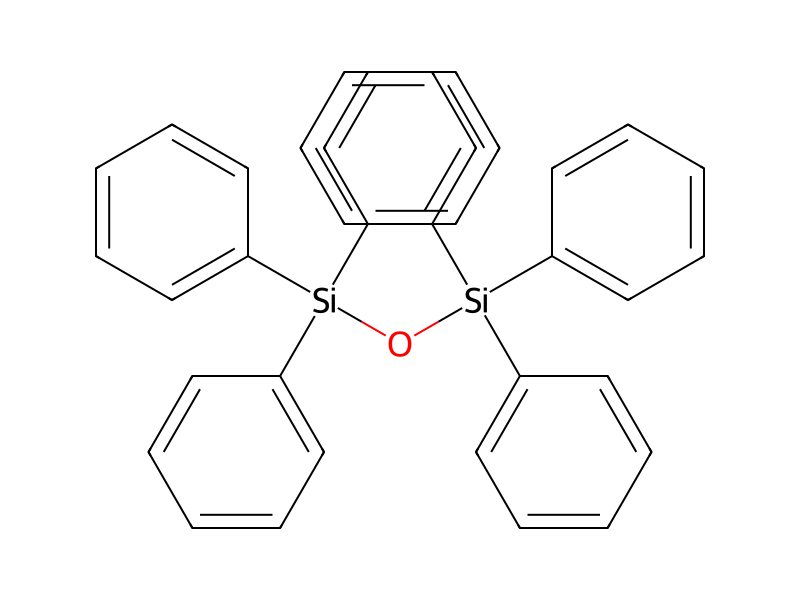
HCID 5943Carbon TetrachlorideHCID 6325EthyleneHCID 69925Triphenylsilanol4×HCID 74587Disiloxane, 1,1,1,3,3,3-hexaphenyl-HCID 10219390chromium (VI) trioxide3×HCID 178526121HCID 178526121, compound4×

Product 2

HCID 64581,1',1''-(Chlorosilylidyne)tris(benzene)HCID 178526121HCID 178526121, compound

Reagents, catalysts & solvents 3

HCID 176Acetic AcidSolventHCID 6342AcetonitrileSolventHCID 8008ButyronitrileSolvent

Procedure

Bistriphenylsilyl chromate is usually used as the catalyst of unsaturated hydrocarbon compound polymerization such as ethylene polymerization. With respect to its synthesis process, early in 1958, U.S. Pat. 7,863,891 disclosed a process wherein bistriphenylsilyl chromate can be obtained with a yield of 85% by reacting triphenylsilanol and chromium trioxide in glacial acetic acid at 50° C. for 10 minutes. L. M. Bakert et al disclosed a process wherein bistriphenylsilyl chromate can be obtained with a yield of about 60% by reacting triphenylsilanol and chromium trioxide in carbon tetrachloride at room temperature for 24 hours [J. Org. Chem., Vol. 85, No. 8, pp. 774-776, March 1970]. The former Czechoslovakia Patent CS 175856 disclosed a process wherein bistriphenylsilyl chromate can be obtained with a yield of 43-71% by reacting triphenylsilanol or triphenylsilyl ether and chromium trioxide in acetonitrile or propyl cyanide. However, the starting material triphenylsilanol used in the above processes is obtained by the hydrolysis of triphenylchlorosilane, so the process for the preparation of bistriphenylsilyl chromate is relatively complicated and the yield thereof is relatively low. The former Soviet Union Patent SU 689192 .disclosed a process wherein bistriphenylsilyl chromate can be obtained with a yield of 94% by reacting triphenylchlorosilane and potassium dichromate in glacial acetic acid at 40°-50° C. for 1.5 hours. The reaction equation thereof is as follows: ##STR1##

Workup

  1. customWith respect to its synthesis process
  2. customcan be obtained with a yield of 85%
  3. customat 50° C.
  4. customfor 10 minutes
  5. customcan be obtained with a yield of about 60%
  6. customat room temperature
  7. customfor 24 hours
  8. customcan be obtained with a yield of 43-71%

Sources & evidence

ORD record
ord-8970a1da8b70416caac798b0fa5410c7
Source dataset
uspto-grants-1997_12
DOI
10.6084/m9.figshare.5104873.v1
Patent number
US05698723

Reaction notes

On this pageParticipantsProcedureWorkupSources & evidenceReaction notes