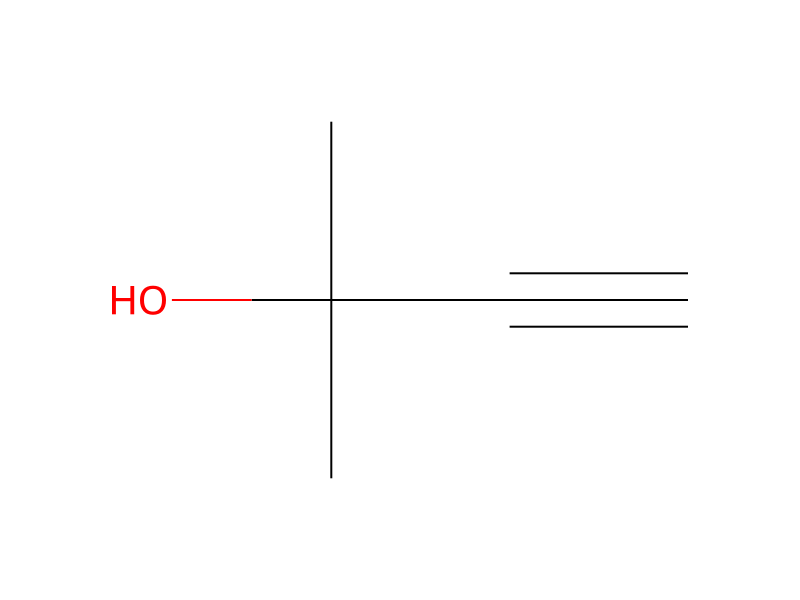
2-Methyl-3-butyn-2-ol → HCID 22959839, compound
Reaction equation

Br[C:2]1[CH:3]=[C:4]([CH3:10])[C:5]([Cl:9])=[CH:6][C:7]=1[F:8].[CH3:11][C:12]([OH:16])([C:14]#[CH:15])[CH3:13]>>[Cl:9][C:5]1[C:4]([CH3:10])=[CH:3][C:2]([C:15]#[C:14][C:12]([CH3:13])([OH:16])[CH3:11])=[C:7]([F:8])[CH:6]=1Participants
3


Procedure
By the method of Example (IV-1), 100 mmol of 3-bromo-6-chloro-4-fluoro-toluene are reacted with 2-methyl-3-butin-2-ol to give 1-(4-chloro-2-fluoro-5-methyl-phenyl)-3-methyl-1-butin-3-ol, except that the mixture is only filtered after the reaction and not concentrated. The filtrate is then admixed with 1.5 g of sodium hydroxide (powder) and the mixture is heated to the boil in a distillation apparatus (with Vigreux column). Distillate is continuously removed, until the boiling point of triethylamine (89° C. ) is reached. The mixture is then allowed to cool, filtered and washed with some ml of triethylamine. The filtrate is subsequently subjected to fractional distillation.
Sources & evidence
- ORD record
- ord-b45026ef8aa5487194d43ca965a00fa0
- Source dataset