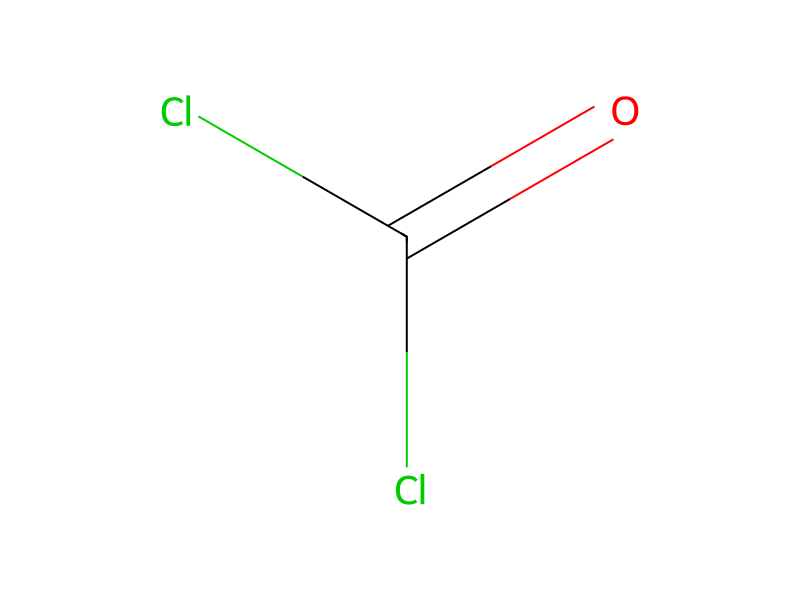
Phosgene → Ethyl 2,4-dioxo-1-phenyl-3-oxa-1,8-diazaspiro[4,5]decane-8-carboxylate
HRID 1973795
Reaction equation

[C:1](Cl)(Cl)=[O:2].[NH:5]([C:12]1([C:23]([OH:25])=[O:24])[CH2:17][CH2:16][N:15]([C:18]([O:20][CH2:21][CH3:22])=[O:19])[CH2:14][CH2:13]1)[C:6]1[CH:11]=[CH:10][CH:9]=[CH:8][CH:7]=1>O1CCOCC1>[O:2]=[C:1]1[O:24][C:23](=[O:25])[C:12]2([CH2:13][CH2:14][N:15]([C:18]([O:20][CH2:21][CH3:22])=[O:19])[CH2:16][CH2:17]2)[N:5]1[C:6]1[CH:7]=[CH:8][CH:9]=[CH:10][CH:11]=1Participants
4
Reactant 2

Product 1

Reagents, catalysts & solvents 1

Procedure
Phosgene gas is introduced through a stirring mixture of 29.2 parts of 4-anilino-1-(ethoxycarbonyl)isonipecotic acid in 240 parts of dioxane; exothermic reaction (temperature rises to 45° C). Stirring is continued for 30 minutes at 45° C. The mixture is heated to reflux and phosgene gas is gently introduced for 2h.30. Then nitrogen gas is introduced for 30 minutes. The reaction mixture is evaporated in a boiling water-bath for 30 minutes. The solid residue is triturated in ether, yielding ethyl 2,4-dioxo-1-phenyl-3-oxa-1,8-diazaspiro [4,5]decane-8-carboxylate; mp. 210.7° C.