HomeMCPWorkbenchSkills
HomeWorkbenchNotificationsMe
llms.txt · MCP GuidePrivacy Policy · Terms of Service · Supportv1.8.3
  1. Home
  2. /Reaction

Sodium Hydroxide → HCID 178506296, compound

HRID 1983016
Print

Reaction equation

HRID 1983016 reaction equation
[F:1][C:2]([F:9])([F:8])[C:3]1[CH:7]=[CH:6][NH:5][N:4]=1.[OH-].[Na+].[Br:12]Br>O>[Br:12][C:7]1[C:3]([C:2]([F:9])([F:8])[F:1])=[N:4][NH:5][CH:6]=1
ParticipantsConditionsProcedureWorkupSources & evidenceReaction notes

Participants

5

Reactant 3

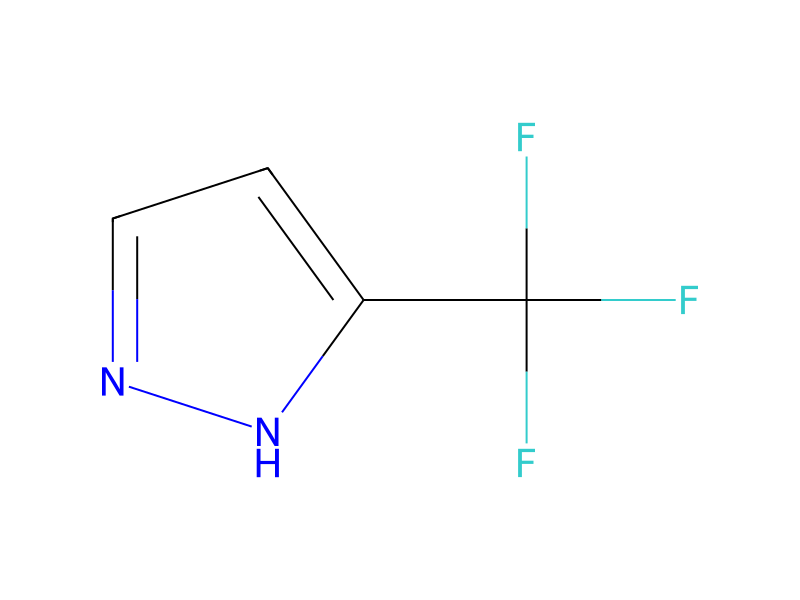
HCID 14798Sodium HydroxideHCID 24408BromineHCID 18070343-(Trifluoromethyl)pyrazole

Product 1

HCID 178506296HCID 178506296, compoundYield 78.5%

Reagents, catalysts & solvents 1

HCID 962WaterSolvent

Conditions

Temperature
0 °C

Procedure

3.50 g of 3-(trifluoromethyl)-1H-pyrazole was suspended in 45 ml of water, and 3.2 g of 50% aqueous solution of sodium hydroxide was added to it. The mixture was cooled to 0° C., and then 3.20 g of bromine was added to the mixture, followed by stirring at room temperature for 7 hours. The reaction mixture was extracted by ethyl acetate. The organic layer was washed with water dried over anhydrous magnesium sulfate, filtered, and concentrated under reduced pressure. Hexane was added to the residue, as a result, a crystal was formed. The crystal was collected to obtain 3.38 g of 4-bromo-3-(trifluoromethyl)-1H-pyrazole.

Workup

  1. extractionThe reaction mixture was extracted by ethyl acetate
  2. washThe organic layer was washed with water
  3. dry with materialdried over anhydrous magnesium sulfate
  4. filtrationfiltered
  5. concentrationconcentrated under reduced pressure
  6. additionHexane was added to the residue, as a result
  7. customa crystal was formed
  8. customThe crystal was collected

Sources & evidence

ORD record
ord-58dc828c44e241b99546b12876d596e3
Source dataset
uspto-grants-2009_06
DOI
10.6084/m9.figshare.5104873.v1
Patent number
US07541374B2

Reaction notes

On this pageParticipantsConditionsProcedureWorkupSources & evidenceReaction notes