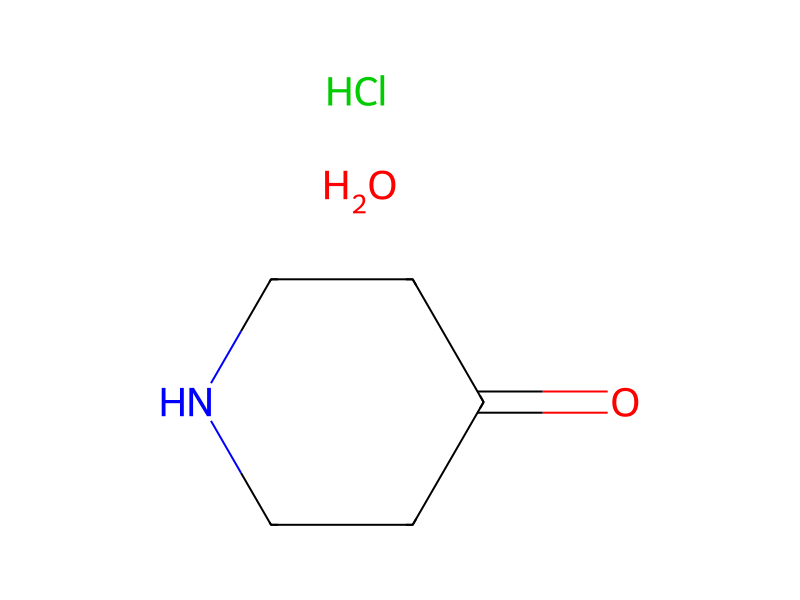
[Cl:1][C:2]1[CH:7]=[CH:6][C:5]([C:8]([NH:10][CH2:11][C:12]2[S:16][C:15]([S:17](Cl)(=[O:19])=[O:18])=[CH:14][CH:13]=2)=[O:9])=[CH:4][CH:3]=1.O.Cl.[NH:23]1[CH2:28][CH2:27][C:26](=[O:29])[CH2:25][CH2:24]1>C(Cl)(Cl)Cl.[OH-].[Na+]>[Cl:1][C:2]1[CH:7]=[CH:6][C:5]([C:8]([NH:10][CH2:11][C:12]2[S:16][C:15]([S:17]([N:23]3[CH2:28][CH2:27][C:26](=[O:29])[CH2:25][CH2:24]3)(=[O:19])=[O:18])=[CH:14][CH:13]=2)=[O:9])=[CH:4][CH:3]=1A solution of 5-({[1-(4-Chloro-phenyl)-methanoyl]-amino}-methyl)-thiophene-2-sulfonyl chloride (1b) (5.0 g, 14 mmol) in 100 ml chloroform and a solution of 4-piperidinone hydrochloride monohydrate (4.3 g, 28 mmol) in 21 ml of NaOH (2N) were stirred vigorously for 15 h. The reaction was quenched with HCl (2N) and the organic layer was extracted twice with HCl (2N) and twice with brine. The dried organic phase affords after evaporation of chloroform 5.8 g (99.5%) of (63c) as a colourless solid: 1H NMR (CDCl3) δ7.67 (d, J=8.7 Hz, 2H), 7.42-7.38 (m, 3H), 6.99 (d, J=3.8 Hz, 1H), 6.53 (t, J=5.3 Hz, 1H), 4.74 (d, J=6.0 Hz, 2H), 3.37 (d, J=6.2 Hz, 4H), 2.50 (d, H=6.2 Hz, 4H).
Loading…