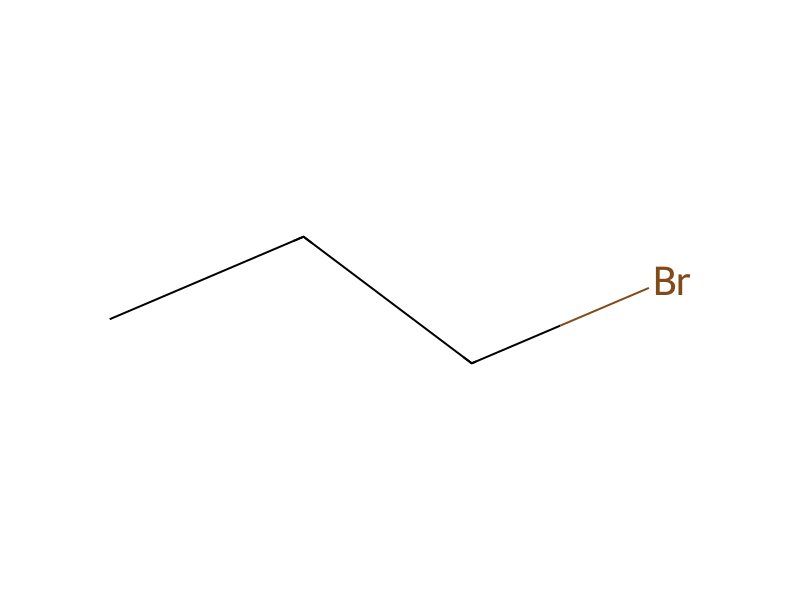
1-Bromopropane → HCID 178456449, compound
Reaction equation

[NH2:1][N:2]1[CH:6]=[N:5][N:4]=[CH:3]1.[Br:7][CH2:8][CH2:9][CH3:10].NN1C=NN=C1.C(#N)C>C(#N)C>[Br-:7].[CH2:8]([N+:5]1[N:4]=[CH:3][N:2]([NH2:1])[CH:6]=1)[CH2:9][CH3:10]Participants
5
Reactant 3


Product 1

Reagents, catalysts & solvents 1

Procedure
10.005 g 118 mmoles of 4-amino-1,2,4-triazole was weighed out and transferred to a three necked 500 ml, round bottom flask and dissolved 200 ml of acetonitrile. The solution then was stirred vigorously with an overhead stirrer the flask equipped with a reflux condenser and placed in a hot oil bath (50° C.) and allowed to heat. In a graduated cylinder, 1-bromopropane 58.865 g, 478 mmoles, was weighed out and then was slowly added to the hot 4-amino-1,2,4-triazole/acetonitrile mixture. The reaction mixture was stirred with heating for 36 hours, being monitored by thin layer chromatography, at which time the 4-amino-1,2,4-triazole was consumed. The flask was then removed from the oil bath, cooled under nitrogen atmosphere. The reaction solution was transferred to a large round bottomed flask and the acetonitrile and excess n-propyl bromide rotary evaporated away. The resultant oil was transferred to a preweighed Schlenk flask, rinsing the large flask with three 10 ml aliquots of fresh acetonitrile. The flask was evacuated for 20 hours to yield a highly crystalline solid 23.9584 g, 115 mmoles of 1-n-propyl-4-amino-1,2,4-triazolium bromide. Melting point: 63° C.; DSC onset 145° C.,