Reaction equation

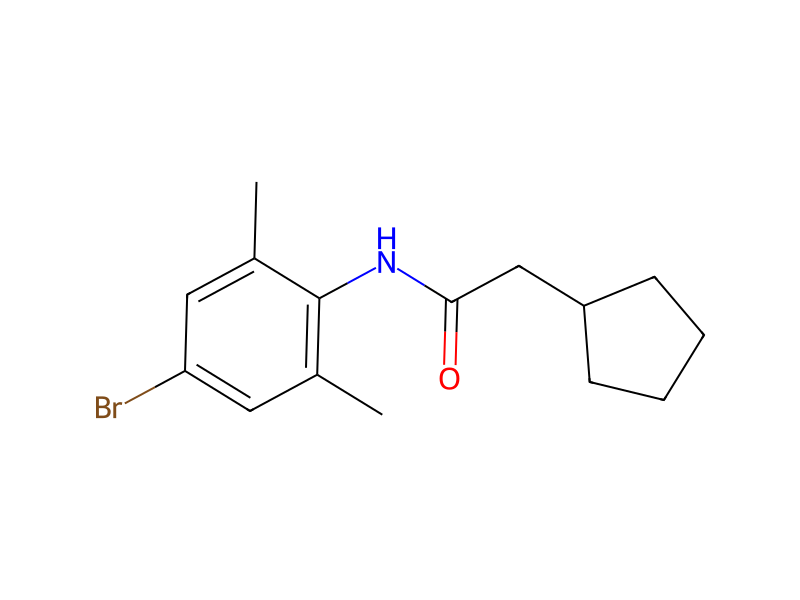
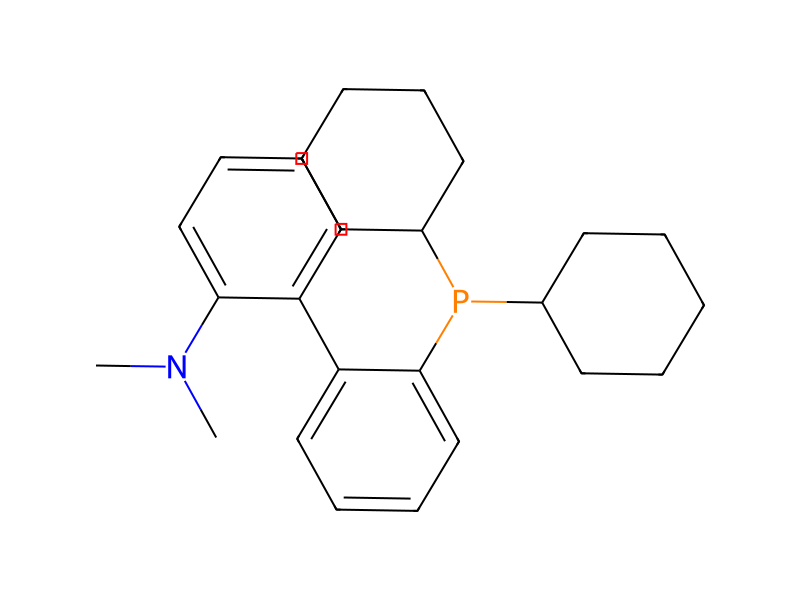
C1COCCN1.Cc1cc(Br)cc(C)c1NC(=O)CC1CCCC1>CC(C)(C)[O-].CN(C)c1ccccc1-c1ccccc1P(C1CCCCC1)C1CCCCC1.Cc1ccccc1.O=C(/C=C/c1ccccc1)/C=C/c1ccccc1.O=C(/C=C/c1ccccc1)/C=C/c1ccccc1.O=C(/C=C/c1ccccc1)/C=C/c1ccccc1.[K+].[Pd].[Pd]>Cc1cc(N2CCOCC2)cc(C)c1NC(=O)CC1CCCC1Participants
Reactant 2

Product 1

Reagents, catalysts & solvents 4



Conditions
- Temperature
- 80 °C
Procedure
Exemplar cmpd from, though employing slightly different Buchwald-Hartwig coupling conditions. Tris(dibenzylidenacetone)dipalladium(0) (31 mg, 0.03 mmol) and 2'-(dicyclohexylphosphino)-N,N-dimethylbiphenyl-2-amine (27 mg, 0.07 mmol) were stirred in anhydrous toluene (3 mL) for 15 minutes under an argon (g) sparge. To the stirring soluntion was added the N-(4-bromo-2,6-dimethylphenyl)-2-cyclopentylacetamide (208 mg, 0.67 mmol) and morpholine (0.070 mL, 0.80 mmol) neat, followed by the potassium tert-butoxide (1M in THF) (0.94 mL, 0.94 mmol) via syringe. he mixture was then heated in a sealed vessel to 80 °C for 18hrs before cooling to ambint temperature. The mixture was filtered thru a 0.7uM GMF. The resultant crude solution was subject to flash chromatorgraphy (SiO2 \- 12 g; gradient elution: 100% hexanes for 1 minute then 0% - 85% EtOAc/Hexane over 14 minutes at 30 mL/min) via detection with UV light at 254nm. The appropriate fractions were then stirred over decolorizing carbon (Norit neutral), filtered thru Celite and concentrated to afford the 2-cyclopentyl-N-(2,6-dimethyl-4-morpholinophenyl)acetamide (47.0 mg, 22.17 %) as a white solid in 90% purity by 1H NMR (CDCl3), though TLC and LCMS reveal one peak. The resultant solid was subject to flash chromatorgraphy (basic alumina - 24 g; gradient elution: 5% EtOAc/Hexane for 1.5 minutes then 5% - 100% EtOAc/Hexane over 11 minutes at 30 mL/min) via detection with UV light at 254nm to afford 2-cyclopentyl-N-(2,6-dimethyl-4-morpholinophenyl)acetamide (28.0 mg, 13.21 %) again what appears to be ~80% purity by 1H NMR (CDCl3), though TLC and LCMS reveal one peak. Aliqout was provided to for SFC analysis wherein all conditions examined reveal only one peak (attached). 1H NMR analysis in DMSO reveals one cmpd. Forming rotamers in CDCl3 with difference exagerated in the morpholino -CH2-N-CH2- protons.
Sources & evidence
- ORD record
- ord-25b2f8bfafe540368db659a4bd1935bf
- Source dataset
- 750 AstraZeneca ELN dataset
- Original link
- View source
Linked notes
Loading…