HomeMCPWorkbenchSkills
HomeWorkbenchNotificationsMe
llms.txt · MCP GuidePrivacy Policy · Terms of Service · Supportv1.8.3
  1. Home
  2. /Reaction

2,2,3,3,4,4,4-Heptafluoro-1-phenylbutan-1-one → HCID 21740024, compound

HRID 2082430
Print

Reaction equation

HRID 2082430 reaction equation
[CH3:1][C:2]1[CH:3]=[C:4]([CH:21]=[CH:22][C:23]=1[CH3:24])[O:5][C:6]1[CH:11]=[CH:10][CH:9]=[C:8]([O:12][C:13]2[CH:18]=[CH:17][C:16]([CH3:19])=[C:15]([CH3:20])[CH:14]=2)[CH:7]=1.[F:25][C:26]([F:42])([C:38]([F:41])([F:40])[F:39])[C:27]([C:30]([C:32]1[CH:37]=[CH:36][CH:35]=[CH:34][CH:33]=1)=O)([F:29])[F:28]>[OH-].[Na+]>[CH3:19][C:16]1[C:15]([CH3:20])=[CH:14][C:13]2[O:12][C:8]3[C:9](=[CH:10][C:11]4[C:30]([C:32]5[CH:37]=[CH:36][CH:35]=[CH:34][CH:33]=5)([C:27]([F:29])([F:28])[C:26]([F:42])([F:25])[C:38]([F:41])([F:40])[F:39])[C:21]5[C:4]([O:5][C:6]=4[CH:7]=3)=[CH:3][C:2]([CH3:1])=[C:23]([CH3:24])[CH:22]=5)[C:30]([C:32]3[CH:37]=[CH:36][CH:35]=[CH:34][CH:33]=3)([C:27]([F:28])([F:29])[C:26]([F:42])([F:25])[C:38]([F:41])([F:40])[F:39])[C:18]=2[CH:17]=1
ParticipantsConditionsProcedureWorkupSources & evidenceReaction notes

Participants

5

Reactant 3

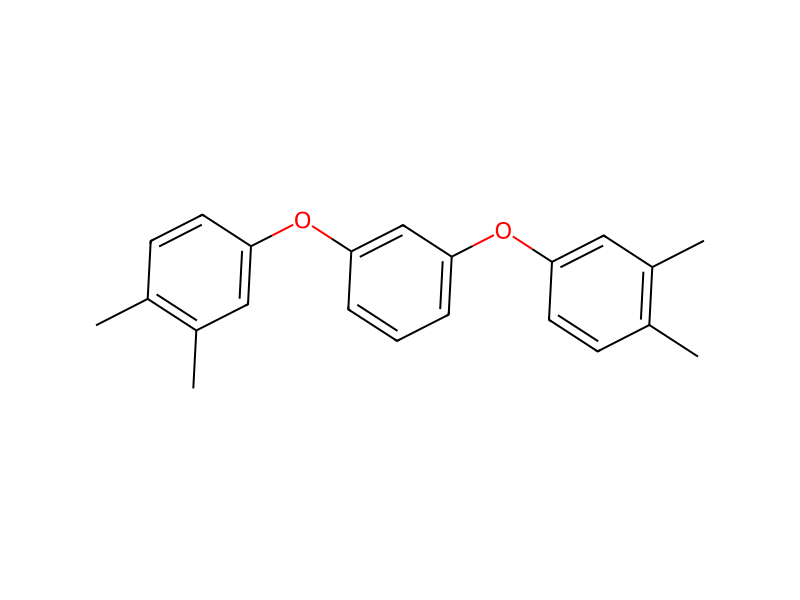
HCID 2384242,2,3,3,4,4,4-Heptafluoro-1-phenylbutan-1-oneHCID 197785641,3-Bis(3,4-dimethylphenoxy)benzeneHCID 178435160HCID 178435160, compound

Product 1

HCID 21740024HCID 21740024, compoundYield 75.1%

Reagents, catalysts & solvents 1

HCID 14798Sodium Hydroxide
Solvent

Conditions

Temperature
140 °C

Procedure

A mixture of 159 g (0.5 mole) 1,3-bis(3,4-dimethylphenoxy)benzene, 274 g (1.0 mole) phenyl heptafluoropropyl ketone, and 280 g (14 moles) HF was heated in an autoclave for 8 hours at 140° C. After cooling, and venting off excess HF, the autoclave contents were transferred to a 1-gallon polyethylene jar, half filled with ice water, and containing 500 ml of 50% sodium hydroxide. The autoclave was rinsed out with methylene chloride, and the washings were added to the jar. The product was extracted with methylene chloride, the extracts were filtered through a layer of alumina, and the solvent was stripped off at atmospheric pressure yielding 312 g of a taffy-like residue, which was very soluble in acetone. The residue was extracted with several 500 ml portions of boiling methanol, and then was stirred with isopropyl alcohol, producing a solid in 21.3 g (5.1 % yield) with a sharp IR spectrum, devoid of OH bands, and melting in the 198-220° C. range, and after recrystallization from heptane at 237-238° C. NMR of the product melting over the wide range showed presence of cis- and trans- isomers: aromatic protons as multiplets 7.05-7.25, 6.85-7.0, broad s 6.66, two broad singlets at 6.58 and 6.50, and methyl singlets at 2.20 and 2.02 ppm in 6:7:2:1(total of the 6.58 and 6.50 peaks): 6:6 ratio. The recrystallized material was a single isomer, by NMR m 7.1, m 7.0, s 6.94, s 6.86, broad s 6.65, broad s 6.47, s 2.23 and s 2.04 ppm in 4:6:2:1:2:1:6:6 ratio. Analysis: calc. for C42H28F14O2 : C 60.7; H 3.37, F 32.0; F 32.0; found C 70.0; H 3.61, F 30.1%.

Workup

  1. temperatureAfter cooling
  2. washThe autoclave was rinsed out with methylene chloride
  3. additionthe washings were added to the jar
  4. extractionThe product was extracted with methylene chloride
  5. filtrationthe extracts were filtered through a layer of alumina

Sources & evidence

ORD record
ord-a729f373f346486a956492ebbede0cc8
Source dataset
uspto-grants-1993_02
DOI
10.6084/m9.figshare.5104873.v1
Patent number
US05189138

Reaction notes

On this pageParticipantsConditionsProcedureWorkupSources & evidenceReaction notes