HomeMCPWorkbenchSkills
HomeWorkbenchNotificationsMe
llms.txt · MCP GuidePrivacy Policy · Terms of Service · Supportv1.8.3
  1. Home
  2. /Reaction

Sodium Carbonate → 2-((2-methyl-6-(trifluoromethyl)pyridin-3-yl)methyl)-8-(pyridin-4-yl)-7-(4-(trifluoromethyl)phenyl)-[1,2,4]triazolo[4,3-a]pyridin-3(2H)-one

HRID 2101288
Print

Reaction equation

HRID 2101288 reaction equation
Cl[C:2]1[CH:7]=[CH:6][N:5]2[C:8](=[O:23])[N:9]([CH2:11][C:12]3[C:13]([CH3:22])=[N:14][C:15]([C:18]([F:21])([F:20])[F:19])=[CH:16][CH:17]=3)[N:10]=[C:4]2[C:3]=1[C:24]1[CH:29]=[CH:28][N:27]=[CH:26][CH:25]=1.[F:30][C:31]([F:42])([F:41])[C:32]1[CH:37]=[CH:36][C:35](B(O)O)=[CH:34][CH:33]=1.C(=O)([O-])[O-].[Na+].[Na+]>C1(C)C=CC=CC=1.C1C=CC([P]([Pd]([P](C2C=CC=CC=2)(C2C=CC=CC=2)C2C=CC=CC=2)([P](C2C=CC=CC=2)(C2C=CC=CC=2)C2C=CC=CC=2)[P](C2C=CC=CC=2)(C2C=CC=CC=2)C2C=CC=CC=2)(C2C=CC=CC=2)C2C=CC=CC=2)=CC=1>[CH3:22][C:13]1[C:12]([CH2:11][N:9]2[C:8](=[O:23])[N:5]3[CH:6]=[CH:7][C:2]([C:35]4[CH:36]=[CH:37][C:32]([C:31]([F:42])([F:41])[F:30])=[CH:33][CH:34]=4)=[C:3]([C:24]4[CH:29]=[CH:28][N:27]=[CH:26][CH:25]=4)[C:4]3=[N:10]2)=[CH:17][CH:16]=[C:15]([C:18]([F:21])([F:20])[F:19])[N:14]=1
ParticipantsConditionsProcedureWorkupSources & evidenceReaction notes

Participants

6

Reactant 3

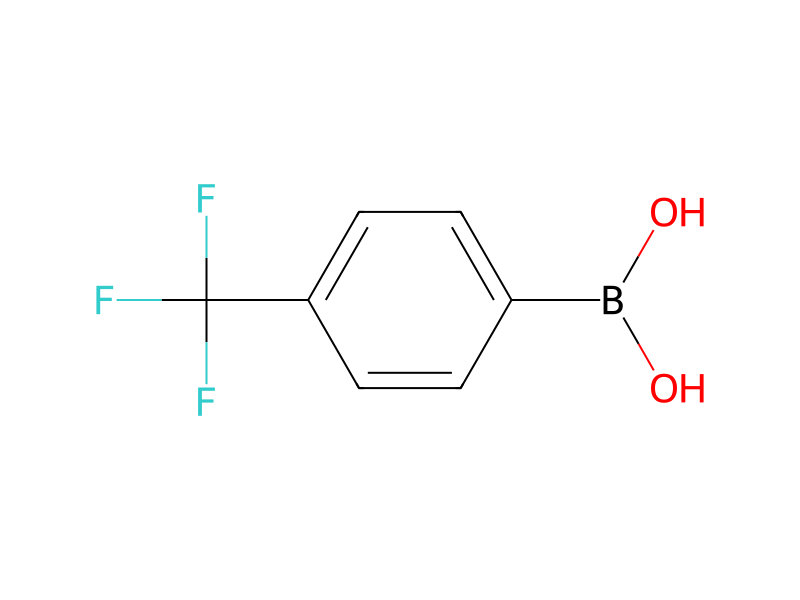
HCID 10340Sodium CarbonateHCID 27343894-(Trifluoromethyl)phenylboronic acidHCID 577994227-chloro-2-((2-methyl-6-(trifluoromethyl)pyridin-3-yl)methyl)-8-(pyridin-4-yl)-[1,2,4]triazolo[4,3-a]pyridin-3(2H)-one

Product 1

HCID 160049052-((2-methyl-6-(trifluoromethyl)pyridin-3-yl)methyl)-8-(pyridin-4-yl)-7-(4-(trifluoromethyl)phenyl)-[1,2,4]triazolo[4,3-a]pyridin-3(2H)-one

Reagents, catalysts & solvents

2
HCID 178418397HCID 178418397, compoundCatalystHCID 1140TolueneSolvent

Conditions

Temperature
100 °C

Procedure

To a suspension of 7-chloro-2-((2-methyl-6-(trifluoromethyl)pyridin-3-yl)methyl)-8-(pyridin-4-yl)-[1,2,4]triazolo[4,3-a]pyridin-3(2H)-one (72 mg, 0.17 mmol), 4-trifluoromethylphenylboronic acid (65 mg, 0.34 mmol), and 2.0 M aqueous sodium carbonate (0.37 mL) in toluene (1.5 mL) was added (Ph3P)4Pd (30 mg, 0.025 mmol) in one portion, and the resulting yellow mixture was vigorously stirred under argon at 100° C. for 1.5 h. After cooling to room temperature, the reaction mixture was partitioned between EtOAc and water. The EtOAc layer was washed with water, then saturated aqueous NaCl twice, dried over Na2SO4, filtered and concentrated under reduced pressure. The crude product was purified using a silica gel cartridge (12 g) eluted with a gradient of EtOAc (0-80%) in hexanes to afford the desired product, which was contaminated with triphenylphosphine oxide. The product was further purified by preparative reverse phase HPLC (Phenomenex Luna 5 μm C-18 21.2×100 mm column eluted with a linear gradient of 50% to 90% B over 12 min (A=90% water, 10% methanol and B=90% methanol, 10% water) with flow rate at 20 mL/min and UV detection at 220 nm). The desired fractions were concentrated under reduced pressure. The yellow residue was dissolved in acetonitrile, frozen and lyophilized to afford 40 mg of the title compound as a light yellow powder. HPLC/MS: retention time=2.92 min, [M+H]+=530.4.

Workup

  1. temperatureAfter cooling to room temperature
  2. customthe reaction mixture was partitioned between EtOAc and water
  3. washThe EtOAc layer was washed with water
  4. dry with materialsaturated aqueous NaCl twice, dried over Na2SO4
  5. filtrationfiltered
  6. concentrationconcentrated under reduced pressure
  7. customThe crude product was purified
  8. washeluted with a gradient of EtOAc (0-80%) in hexanes

Sources & evidence

ORD record
ord-5a6fccce4e694b52980e7b1ceede0122
Source dataset
uspto-grants-2009_08
DOI
10.6084/m9.figshare.5104873.v1
Patent number
US07572808B2

Reaction notes

On this pageParticipantsConditionsProcedureWorkupSources & evidenceReaction notes