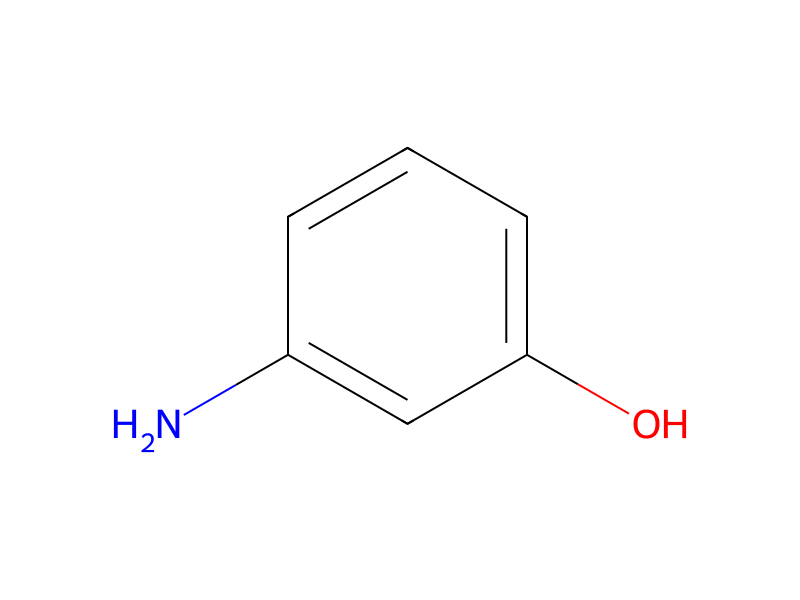
3-Aminophenol → N,N'-bis(3-hydroxyphenyl)-9-oxo-9H-fluorene-2,7-disulfonamide
Reaction equation

[NH2:1][C:2]1[CH:3]=[C:4]([OH:8])[CH:5]=[CH:6][CH:7]=1.[O:9]=[C:10]1[C:22]2[CH:21]=[C:20]([S:23](Cl)(=[O:25])=[O:24])[CH:19]=[CH:18][C:17]=2[C:16]2[C:11]1=[CH:12][C:13]([S:27](Cl)(=[O:29])=[O:28])=[CH:14][CH:15]=2>N1C=CC=CC=1>[OH:8][C:4]1[CH:3]=[C:2]([NH:1][S:27]([C:13]2[CH:14]=[CH:15][C:16]3[C:17]4[C:22](=[CH:21][C:20]([S:23]([NH:1][C:2]5[CH:7]=[CH:6][CH:5]=[C:4]([OH:8])[CH:3]=5)(=[O:25])=[O:24])=[CH:19][CH:18]=4)[C:10](=[O:9])[C:11]=3[CH:12]=2)(=[O:29])=[O:28])[CH:7]=[CH:6][CH:5]=1Participants
4
Reactant 2

Product 1

Reagents, catalysts & solvents 1

Procedure
3-Aminophenol (0.91 g, 8.38 mmol) in pyridine was treated with 9-oxo-9H-fluorene-2,7-disulfonyl dichloride (1.58 g, 4.19 mmol, purchased from Maybridge) in one portion at 0° C. After two hours, the volatiles were removed at reduced pressure and the residue was partitioned between ethyl acetate and H2O. The organic layer was separated, washed with 1N HCl, brine, dried (Na2SO4), filtered, and the filtrate concentrated under reduced pressure. The residue was purified by flash chromatography (8% CH3OH/CH2Cl2) to provide the title compound as a yellow solid (1.97 g, 90% yield). 1H NMR (300 MHz, DMSO-d6) δ 10.31 (s, 2H), 9.50 (s, 2H), 7.97-8.11 (m, 4H), 7.92 (d, 2H), 7.0 (t, 2H), 6.49-6.64 (m, 4H), 6.43 (m, 2H); MS (DCI/NH3) 540 (M+NH4)+.