HCID 178488167, compound → HCID 178462268, compound
Reaction equation
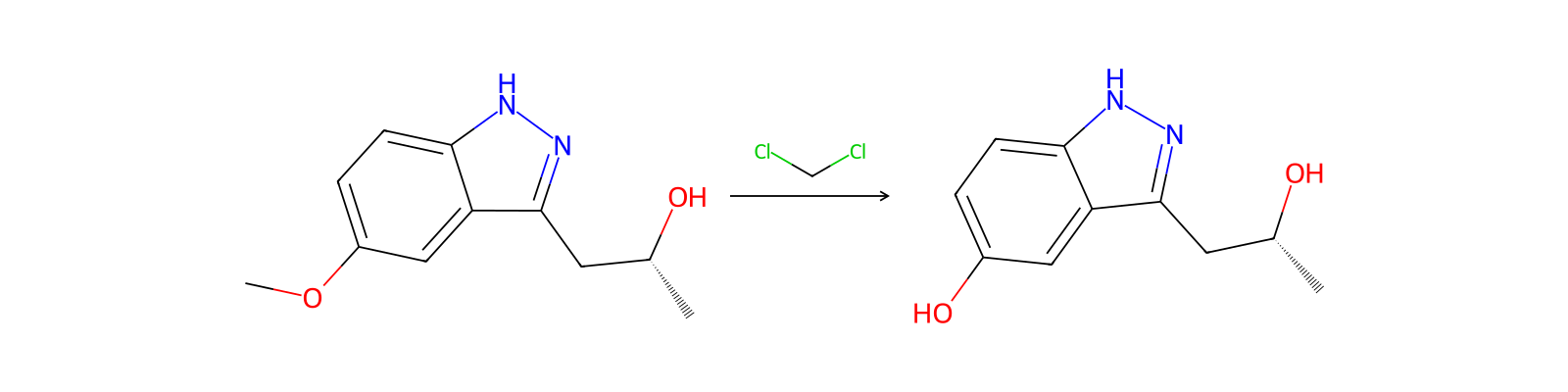
C[O:2][C:3]1[CH:4]=[C:5]2[C:9](=[CH:10][CH:11]=1)[NH:8][N:7]=[C:6]2[CH2:12][C@H:13]([OH:15])[CH3:14]>ClCCl>[OH:15][C@H:13]([CH3:14])[CH2:12][C:6]1[C:5]2[C:9](=[CH:10][CH:11]=[C:3]([OH:2])[CH:4]=2)[NH:8][N:7]=1Participants
3
Reactant 1

Product 1

Reagents, catalysts & solvents 1

Procedure
To a solution of (R)-1-(5-Methoxy-1H-indazol-3-yl)-propan-2-ol (2.31 g, 11.2 mmol) in anhydrous dichloromethane (50 mL) cooled at −78° C. was added a 1 N borontribromide solution in dichloromethane (33.6 mL, 33.6 mmol). After the addition was complete, the mixture was allowed to warm to ambient temperature and stirred for 2 hours. The mixture was cooled (ice bath) and quenched with 20 mL of water. Dichloromethane was evaporated and the residue was mixed with ethyl acetate (100 mL). To this solution potassium carbonate was added in small portions until gas evolution ceased and the pH was about 8. The mixture was extracted with ethyl acetate (3×100 mL) and the combined extracts were dried and evaporated to dryness. Chromatography on silica (gradient, 50% to 90% ethyl acetate in hexane) gave an oil (1.50 g, 70%): LC/MS (+APCI) m/z 193 (M+H).