Acetaldehyde, 2,2-dimethoxy- → Z-2-fluoro-3-methyl-4,4-dimethoxy-2-buten-1-al
HRID 2163835
Reaction equation

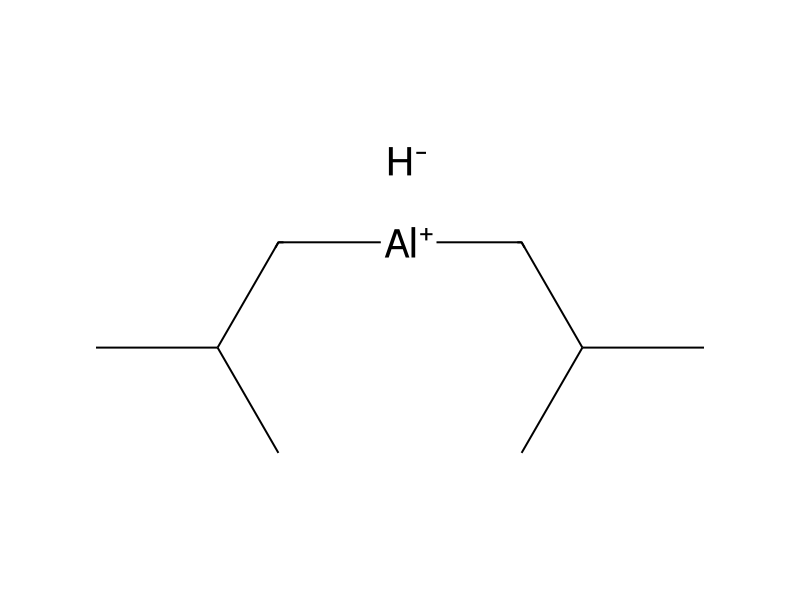
COC(OC)C=O.[F:8]/[C:9](=[C:13](/[CH3:19])\[CH:14]([O:17][CH3:18])[O:15][CH3:16])/[C:10]([O-])=[O:11].[H-].C([Al+]CC(C)C)C(C)C>>[F:8]/[C:9](=[C:13](/[CH3:19])\[CH:14]([O:15][CH3:16])[O:17][CH3:18])/[CH:10]=[O:11]Participants
4



Procedure
The 6-fluoro octatrienoate is prepared by reacting triethyl phosphono fluoroacetate with glyoxal dimethyl acetal and the resulting reaction product, a mixture of ethyl E and Z-2-fluoro-4,4-dimethoxy-3-methyl-2-butenoate, is reduced with di-isobutyl aluminum hydride in the cold to form Z-2-fluoro-3-methyl-4,4-dimethoxy-2-buten-1-al. The latter compound is then reacted via a Horner reaction with a compound of the formula ##STR35## or via a Wittig reaction with ##STR36## wherein X is halogen to form a compound of the formula ##STR37## The latter compound is then treated with hydrochloric acid and diethyl ether to form the 6-fluoro octatrienoate period.