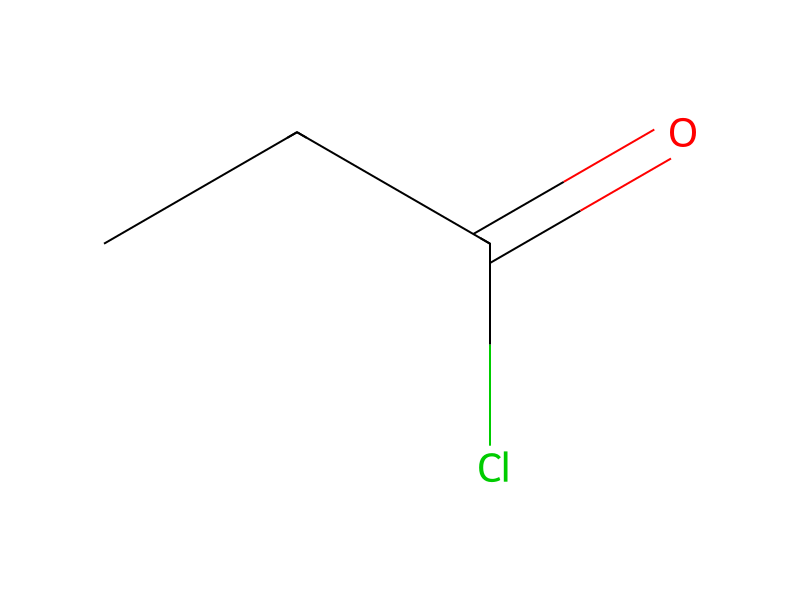
Propionyl chloride → N-(5-tert-Butyl-1H-pyrazol-3-yl)propanamide
HRID 2164497
Reaction equation

[NH2:1][C:2]1[CH:6]=[C:5]([C:7]([CH3:10])([CH3:9])[CH3:8])[NH:4][N:3]=1.[C:11](Cl)(=[O:14])[CH2:12][CH3:13]>O1CCOCC1>[C:7]([C:5]1[NH:4][N:3]=[C:2]([NH:1][C:11](=[O:14])[CH2:12][CH3:13])[CH:6]=1)([CH3:10])([CH3:9])[CH3:8]Participants
4
Reactant 2

Product 1

Reagents, catalysts & solvents 1

Procedure
20 g (0.14 mole) of 3-amino-5-t-butylpyrazole prepared in Example 1 was dissolved in 100 ml of dioxane, and 14 g of propionyl chloride was added thereto. The mixture was allowed to react at 80° C. for 5 hours. After completion of the reaction, the dioxane was distilled off under reduced pressure, and then water was added to the residue whereby the reaction product was dissolved therein. The resulting solution was neutralized with a 10% sodium hydroxide aqueous solution whereby crystals were precipitated. The crystals were collected by filtration, washed with water and benzene, and then dried to obtain 22 g of 5-t-butyl-3-propionylaminopyrazole. This product was recrystallized from methanol and found to have a melting point of 228° to 229° C.