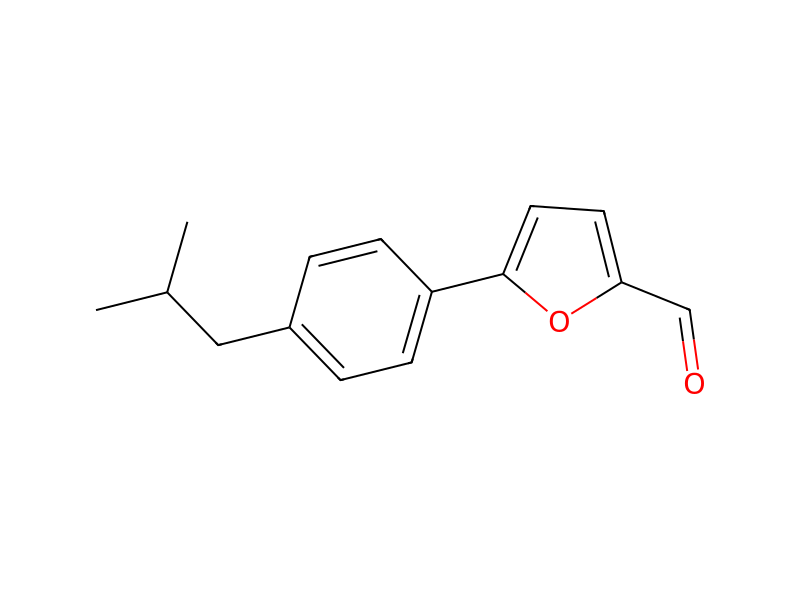
Br[C:2]1[CH:7]=[CH:6][C:5]([CH2:8][CH:9]([CH3:11])[CH3:10])=[CH:4][CH:3]=1.C(=O)([O-])[O-].[Na+].[Na+].[CH2:18](O)[CH3:19].O.[CH3:22][O:23][CH2:24][CH2:25][O:26]C>CCOCC.C1C=CC([P]([Pd]([P](C2C=CC=CC=2)(C2C=CC=CC=2)C2C=CC=CC=2)([P](C2C=CC=CC=2)(C2C=CC=CC=2)C2C=CC=CC=2)[P](C2C=CC=CC=2)(C2C=CC=CC=2)C2C=CC=CC=2)(C2C=CC=CC=2)C2C=CC=CC=2)=CC=1>[CH2:8]([C:5]1[CH:6]=[CH:7][C:2]([C:22]2[O:23][C:24]([CH:25]=[O:26])=[CH:19][CH:18]=2)=[CH:3][CH:4]=1)[CH:9]([CH3:11])[CH3:10]A mixture of 1-bromo-4-isobutylbenzene (1.500 g, 7.04 mmol), 5-formyl-2-furanoboronic acid (1.477, 10.56 mmol) and sodium carbonate (3.134 g, 29.57 mmol) in a mixture of 1,2-dimethoxyethane (75 mL), ethanol (30 mL) and water (15 mL) was vigorously stirred and the reaction flask was purged with nitrogen. Tetrakis(triphenylphosphine)palladium(0) (0.404 g, 0.35 mmol) was added and the reaction mixture was heated at 60° C. for 3 h. The mixture was allowed to cool to room temperature and was left aside for 4 days. The reaction mixture was diluted with ether (200 mL) and washed successively with water (2×100 mL) and brine. The organic layer was separated, dried over sodium sulfate and concentrated. The residue was chromatographed on flash Silica, eluted with 5 to 10% ethyl acetate in hexanes to afford 5-(4-isobutyl-phenyl)-furan-2-carbaldehyde (490 mg, 31%). 1H NMR (400 MHz, CDCl3): 0.92 (6H, d, J=6.4 Hz), 1.90 (1H, m), 2.51 (2H, d, J=7.2 Hz), 6.80 (1H, d, J=3.6 Hz), 7.20 (2H, m), 7.31 (1H, dd, J=3.6, 1.2 Hz), 7.74 (2H, m), 9.63 (1H, s). ESI-MS: 227.1.