HomeMCPWorkbenchSkills
HomeWorkbenchNotificationsMe
llms.txt · MCP GuidePrivacy Policy · Terms of Service · Supportv1.8.3
  1. Home
  2. /Reaction

Sodium Hydroxide → HCID 178521089, compound

HRID 2206890
Print

Reaction equation

HRID 2206890 reaction equation
C(O)[C@@H]([C@H]([C@@H](CO)O)O)[OH:3].[OH2:11].O.O.O.O.O.[Cl-].[Cr+3:18].[Cl-].[Cl-].[OH-].[Na+].[CH2:23]([OH:32])[C@@H:24]([C@H:26]([C@@H:28]([CH2:30][OH:31])[OH:29])[OH:27])[OH:25].[Cr]>O>[OH-:3].[CH2:23]([OH:32])[C@@H:24]([C@H:26]([C@@H:28]([CH2:30][OH:31])[OH:29])[OH:27])[OH:25].[Cr+3:18].[OH-:11].[OH-:3]
ParticipantsProcedureWorkupSources & evidenceReaction notes

Participants

6

Reactant 4

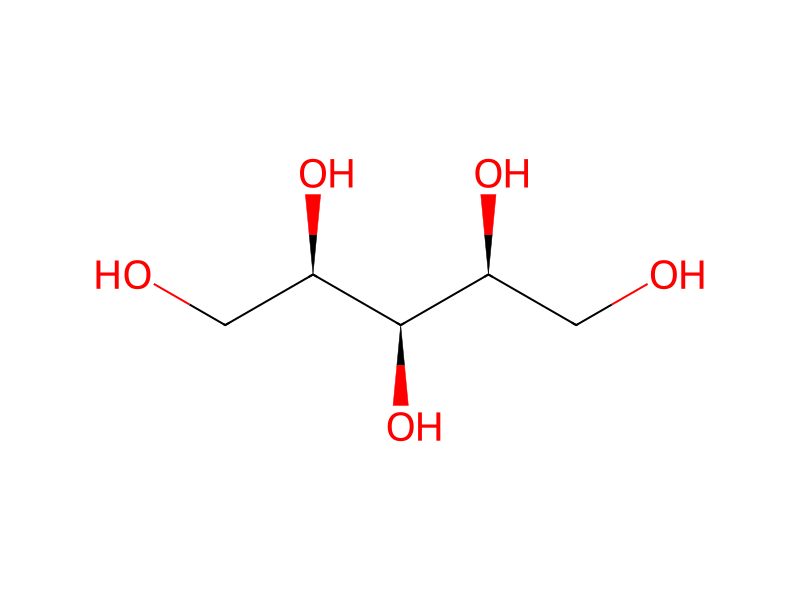
HCID 14798Sodium HydroxideHCID 166918Chromium(3+) trichloride hexahydrateHCID 178418489HCID 178418489, compoundHCID 178521088HCID 178521088, compound

Product 1

HCID 178521089HCID 178521089, compound

Reagents, catalysts & solvents 1

HCID 962
Water
Solvent

Procedure

600 g of xylitol and 140 g of chromium (III) chloride hexahydrate were dissolved in 1200 g of water at 85° C. with stirring to produce a solution. The pH of the solution was raised to about 9 by adding rapidly in one portion a suitable amount of an aqueous solution containing 20 wt % of sodium hydroxide. Within 20 minutes a blue transparent solution having a strong laser scattering characteristic was then obtained. This strong laser scattering property indicated formation of chromium xylitol nanoclusters. The nanoclusters were isolated from the solvent and free ions through cross-flow membrane filtration using a membrane with a molecular weight cut-off at 3500 Dalton. The isolated nanoclusters were further dried in an oven at 80° C. to form a dark red solid, which was further ground into a free flow powder. Atomic absorption spectroscopy of the thus-obtained nanoclusters indicated that the nanoclusters had a chromium content of 8.09 wt. %.


Workup

  1. customto produce a solution
  2. temperatureThe pH of the solution was raised to about 9
  3. additionby adding rapidly in one portion a suitable amount of an aqueous solution
  4. customa strong laser scattering characteristic was then obtained
  5. customThe nanoclusters were isolated from the solvent and free ions through cross-flow membrane filtration
  6. customThe isolated nanoclusters were further dried in an oven at 80° C.
  7. customto form a dark red solid, which
  8. customAtomic absorption spectroscopy of the thus-obtained nanoclusters

Sources & evidence

ORD record
ord-c60bd6482f984622bc7693c9ce42a18f
Source dataset
uspto-grants-2016_06
DOI
10.6084/m9.figshare.5104873.v1
Patent number
US09375449B2

Reaction notes

On this pageParticipantsProcedureWorkupSources & evidenceReaction notes