3-Isocyanatobenzonitrile → (+/-)-1-[1-(2-Chloro-pyrimidin-5-yl)-ethyl]-3-(3-cyano-pheny)-1-(2-fluoro-4-methoxy-phenyl)-urea
Reaction equation

[Cl:1][C:2]1[N:7]=[C:6](Cl)[C:5]([CH:9]([NH:11][C:12]2[CH:17]=[CH:16][C:15]([O:18][CH3:19])=[CH:14][C:13]=2[F:20])[CH3:10])=[CH:4][N:3]=1.[C:21]([C:23]1[CH:24]=[C:25]([N:29]=[C:30]=[O:31])[CH:26]=[CH:27][CH:28]=1)#[N:22]>C1(C)C=CC=CC=1>[Cl:1][C:2]1[N:7]=[CH:6][C:5]([CH:9]([N:11]([C:12]2[CH:17]=[CH:16][C:15]([O:18][CH3:19])=[CH:14][C:13]=2[F:20])[C:30]([NH:29][C:25]2[CH:26]=[CH:27][CH:28]=[C:23]([C:21]#[N:22])[CH:24]=2)=[O:31])[CH3:10])=[CH:4][N:3]=1Participants
4
Reactant 2
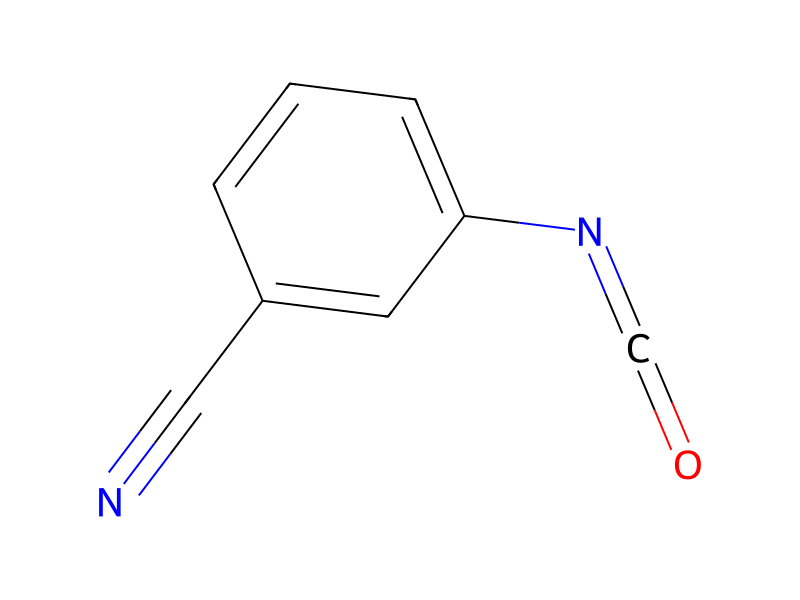

Product 1

Reagents, catalysts & solvents 1

Procedure
(±)-[1-(2,4-Dichloro-pyrimidin-5-yl)-ethyl]-(2-fluoro-4-methoxy-phenyl)-amine (1.15 g; 3.63 mmol) (from Example 8b supra) was combined with 3-cyanophenyl isocyanate (0.55 g; 3.81 mmol) (Aldrich) in toluene (10 mL) and heated in an oil bath at 110–115° C. for 2 hours and then up to 128° C. over the next 3 hours. Upon cooling to room temperature, the reaction was concentrated and triturated with hexanes. The crude material was purified by flash chromatography (Biotage, 40M; 50:50 ethyl acetate-hexanes) to give the intermediate (±)-1-[1-(2-chloro-pyrimidin-5-yl)-ethyl]-3-(3-cyano-pheny)-1-(2-fluoro-4-methoxy-phenyl)-urea. (Yield 1.20 g; 71.8%).