Reaction equation

[NH2:1][C:2]1[CH2:7][CH2:6][CH2:5][C:4](=[O:8])[CH:3]=1.Cl.CN(C)[CH2:12][CH2:13][C:14]([C:16]1[CH:21]=[CH:20][CH:19]=[CH:18][CH:17]=1)=O.C(=O)([O-])[O-].[Na+].[Na+]>C(O)(=O)C>[C:16]1([C:14]2[CH:13]=[CH:12][C:3]3[C:4](=[O:8])[CH2:5][CH2:6][CH2:7][C:2]=3[N:1]=2)[CH:21]=[CH:20][CH:19]=[CH:18][CH:17]=1Participants
5


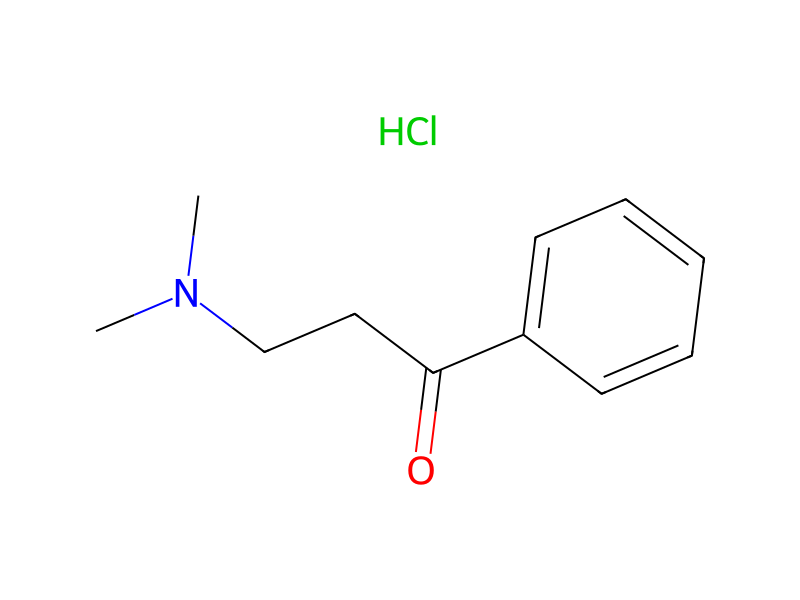


Procedure
3-Aminocyclohexenone (5.55 g, 50 mmol) and 3-dimethylaminopropiophenone hydrochloride (10.65 g, 50 mmol) were suspended in glacial acetic acid (15 mL) and heated at reflux for 1 h. The mixture was cooled to room temperature and cautiously poured into 20% aqueous sodium carbonate. After gas evolution ceased the residue was extracted with chloroform, dried over anhydrous sodium carbonate, filtered and evaporated. Purification by chromatography on silica gel using 1:1 chloroform/dichloromethane as eluant provided 2.95 g (26%) of 2-phenyl-7,8-dihydroquinolin-5(6H)-one as an off-white solid, mp 128°-130° C.; 1H NMR (CDCl3) δ8.32 (d, 1H), 8.05 (dd, 2H), 7.66 (d, 2H), 7.55-7.42 (m,3H), 3.21 (t, 2H), 2.72 (t, 2H), 2.22 (m, 2H).
Workup
- temperatureheated
- temperatureat reflux for 1 h
- extractionwas extracted with chloroform
- dry with materialdried over anhydrous sodium carbonate
- filtrationfiltered
- customevaporated
- customPurification by chromatography on silica gel using 1:1 chloroform/dichloromethane as eluant
Sources & evidence
- ORD record
- ord-852f8e27267742b2bba40926c63cae3a
- Source dataset
- uspto-grants-1995_06
- Patent number
- US05428040
Linked notes
Loading…