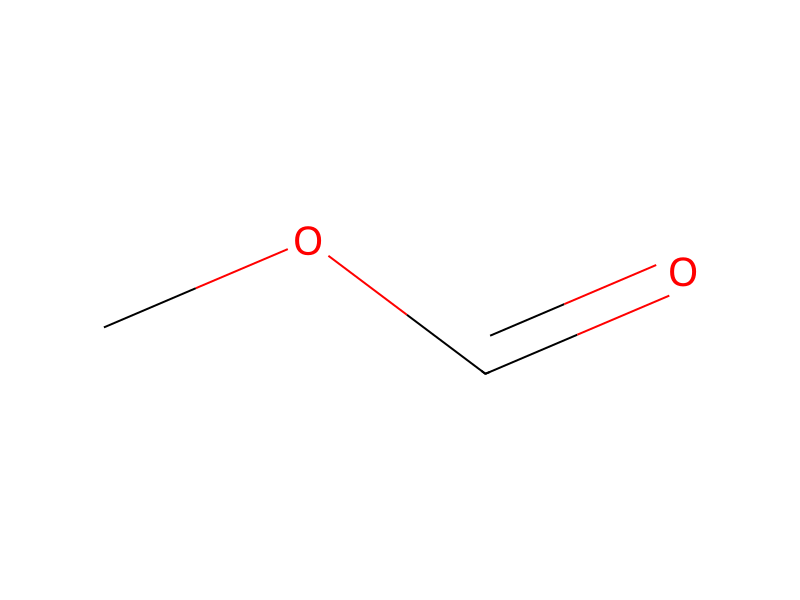
[Cl:1][C:2]([Cl:20])([Cl:19])[CH:3]1[O:8][CH:7]([C:9]([Cl:12])([Cl:11])[Cl:10])[C:6]2[CH:13]=[C:14]([CH:17]=[O:18])[CH:15]=[CH:16][C:5]=2[O:4]1.[Cl-].[Al+3].[Cl-].[Cl-].[H-].[Al+3].[Li+].[H-].[H-].[H-].[CH:31](OC)=[O:32].S(=O)(=O)(O)O>C(OCC)C>[CH:31]([O:18][CH2:17][C:14]1[CH:15]=[CH:16][C:5]2[O:4][CH:3]([C:2]([Cl:1])([Cl:19])[Cl:20])[O:8][CH:7]([C:9]([Cl:12])([Cl:10])[Cl:11])[C:6]=2[CH:13]=1)=[O:32]A solution of 2,4-bis(trichloromethyl)benzo[1,3]dioxin-6-carboxaldehyde (1.0 g.) in diethylether (10 ml.) was added to a mixture of aluminium chloride (1.17 g.) and lithium aluminium hydride (0.95 g.) in diethyl ether (15 ml.). A vigorous reaction was observed during this addition, the mixture was stirred for 11/2 hours, and then a solution of methyl formate (5 ml.) in diethyl ether (20 ml.) was added at 0° C. The reaction mixture was allowed to reach ambient temperature, and 20% sulphuric acid (25 ml.) was added. The organic layer was separated, dried, and concentrated under reduced pressure to give an oily product which readily solidified on trituration with petroleum ether (b.p. 60°-80° C.) to give 6-formyloxymethyl-2,4-bis(trichloromethyl)benzo[1,3]dioxin, m.p. 75°-77° C.