Reaction equation

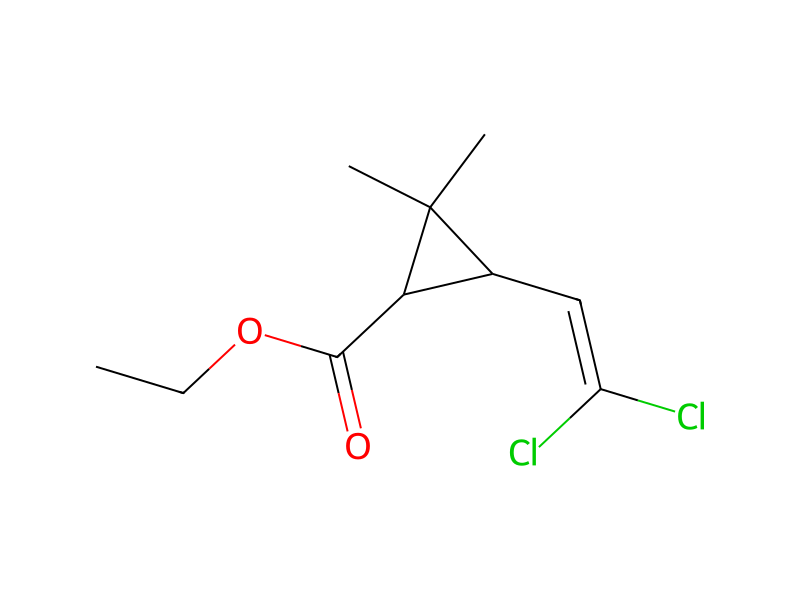
[C:1]([CH:3]1[CH:5]([CH:6]=[C:7]([Cl:9])[Cl:8])[C:4]1([CH3:11])[CH3:10])#N.S(=O)(=O)(O)[OH:13].[CH2:17]([OH:19])[CH3:18]>O>[Cl:8][C:7]([Cl:9])=[CH:6][CH:5]1[CH:3]([C:1]([O:19][CH2:17][CH3:18])=[O:13])[C:4]1([CH3:11])[CH3:10]Participants




Conditions
- Temperature
- 80 °C
Procedure
The procedure described in Example 2 is repeated up to the point at which the mixture of 1-cyano-3-(2',2'-dichlorovinyl)-2,2-dimethylcyclopropane, sulphuric acid and water has been heated and stirred at 80° C. for 6 hours and then cooled below 30° C. 16 Parts of ethanol are added to the reaction mixture below 50° C. The mixture is then heated at 100° C. for a further 12 hours, cooled to 20° C. and drowned into 100 parts of water. The aqueous mixture is extracted with toluene (2×50 parts), the toluene extracts are combined and the solvent is removed by evaporation under reduced pressure. There are obtained 17.6 parts of ethyl 3-(2',2'-dichlorovinyl)-2,2-dimethylcyclopropane-1-carboxylate as a brown oil containing 40.4% of the cis-isomer and 21.8% of the trans-isomer. The overall yield is 92.4%.
Workup
- temperaturehas been heated
- temperaturecooled below 30° C
- temperatureThe mixture is then heated at 100° C. for a further 12 hours
- temperaturecooled to 20° C.
- extractionThe aqueous mixture is extracted with toluene (2×50 parts)
- customthe solvent is removed by evaporation under reduced pressure
Sources & evidence
- ORD record
- ord-46720017eb7d4bcf80f5d3cbefa631db
- Source dataset
- uspto-grants-1980_11
- Patent number
- US04236018
Linked notes
Loading…