HomeMCPWorkbenchSkills
HomeWorkbenchNotificationsMe
llms.txt · MCP GuidePrivacy Policy · Terms of Service · Supportv1.8.3
  1. Home
  2. /Reaction

Lithium Chloride → HCID 59594391, compound

HRID 2263704
Print

Reaction equation

HRID 2263704 reaction equation
[Br:1][C:2]1[CH:23]=[CH:22][CH:21]=[CH:20][C:3]=1[CH2:4][CH:5]1[C:11](=[O:12])[N:10]([CH3:13])[C:9]2[CH:14]=[CH:15][C:16]([Cl:18])=[CH:17][C:8]=2[C:7](Cl)=[N:6]1.CC1(C)C(C)(C)OB([C:32]2[CH:41]=[CH:40][C:35]3[NH:36][C:37](=[O:39])[NH:38][C:34]=3[CH:33]=2)O1.[Cl-].[Li+].O.[OH-].[Cs+]>[Pd].C1(P(C2C=CC=CC=2)C2C=CC=CC=2)C=CC=CC=1.C1(P(C2C=CC=CC=2)C2C=CC=CC=2)C=CC=CC=1.C1(P(C2C=CC=CC=2)C2C=CC=CC=2)C=CC=CC=1.C1(P(C2C=CC=CC=2)C2C=CC=CC=2)C=CC=CC=1.O.O1CCOCC1>[Br:1][C:2]1[CH:23]=[CH:22][CH:21]=[CH:20][C:3]=1[CH2:4][CH:5]1[C:11](=[O:12])[N:10]([CH3:13])[C:9]2[CH:14]=[CH:15][C:16]([Cl:18])=[CH:17][C:8]=2[C:7]([C:32]2[CH:41]=[CH:40][C:35]3[NH:36][C:37](=[O:39])[NH:38][C:34]=3[CH:33]=2)=[N:6]1
ParticipantsConditionsProcedureWorkupSources & evidenceReaction notes

Participants

8

Reactant 4

HCID 433294Lithium ChlorideHCID 23679066Caesium hydroxide--water (1/1/1)HCID 438110655-(4,4,5,5-Tetramethyl-1,3,2-dioxaborolan-2-yl)-1H-benzo[d]imidazol-2(3H)-oneHCID 59594377(E)-3-(2-bromobenzyl)-5,7-dichloro-1-methyl-1H-benzo[e][1,4]diazepin-2(3H)-one

Product 1

HCID 59594391HCID 59594391, compound
Yield 19%

Reagents, catalysts & solvents 3

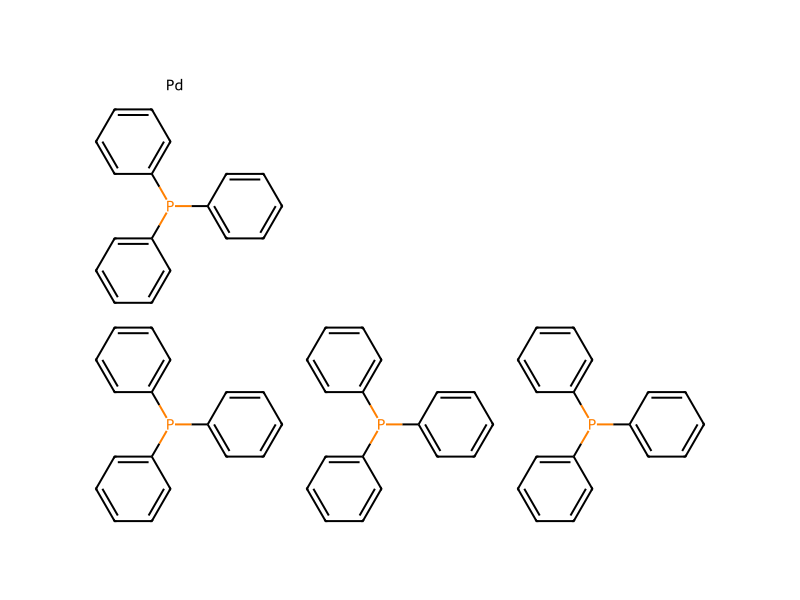
HCID 11979704Tetrakis(triphenylphosphine)palladiumCatalystHCID 962WaterSolventHCID 312751,4-DioxaneSolvent

Conditions

Temperature
100 °C

Procedure

(E)-3-(2-Bromobenzyl)-5,7-dichloro-1-methyl-1H-benzo[e][1,4]diazepin-2(3H)-one (150 mg, 0.364 mmol), 5-(4,4,5,5-tetramethyl-1,3,2-dioxaborolan-2-yl)-1H-benzo[d]imidazol-2(3H)-one (95 mg, 0.364 mmol) and lithium chloride (46 mg, 1.09 mmol) were added to 1,4-dioxane (3 mL). Nitrogen was bubbled into the solution as reagents were added. Tetrakis(triphenylphosphine) palladium(0) (42 mg, 0.036 mmol) was added followed by cesium hydroxide monohydrate (183 mg, 1.09 mmol) and water (1 mL). After bubbling nitrogen through for 5 minutes, the reaction mixture was heated to 100° C. under a nitrogen atmosphere. After heating for 1 hour, the mixture was cooled to ambient temperature, diluted with ethyl acetate (25 mL), washed with water (2×20 mL), then brine (20 mL), dried with sodium sulfate, decanted then concentrated in the presence of silica. The dried silica-bound residue was dry loaded onto a silica gel column and eluted with a gradient of 60-100% ethyl acetate in hexanes then a gradient of 0-25% methanol in ethyl acetate to yield (Z)-3-(2-bromobenzyl)-7-chloro-1-methyl-5-(2-oxo-2,3-dihydro-1H-benzo[d]imidazol-5-yl)-1H-benzo[e][1,4]diazepin-2(3H)-one (35 mg, 19%). 1H NMR (300 MHz, DMSO-d6) δ 3.32 (s, 3H) 3.49 (m, 2H), 3.82 (t, 1H), 6.89-7.17 (m, 3H), 7.28-7.71 (m, 7H), 10.70 (s, 1H), 10.87 (s, 1H); ESI m/z measured 509.0359 [M+H]+, calculated 509.0380.

Workup

  1. customNitrogen was bubbled into the solution as reagents
  2. additionwere added
  3. customAfter bubbling nitrogen through for 5 minutes
  4. temperatureAfter heating for 1 hour
  5. temperaturethe mixture was cooled to ambient temperature
  6. additiondiluted with ethyl acetate (25 mL)
  7. washwashed with water (2×20 mL)
  8. dry with materialbrine (20 mL), dried with sodium sulfate
  9. customdecanted
  10. concentrationthen concentrated in the presence of silica
  11. customThe dried silica-bound residue was dry
  12. washeluted with a gradient of 60-100% ethyl acetate in hexanes

Sources & evidence

ORD record
ord-0bbcfc405fa041d095f82170bd829a3a
Source dataset
uspto-grants-2010_12
DOI
10.6084/m9.figshare.5104873.v1
Patent number
US07851465B2

Reaction notes

On this pageParticipantsConditionsProcedureWorkupSources & evidenceReaction notes