Reaction equation

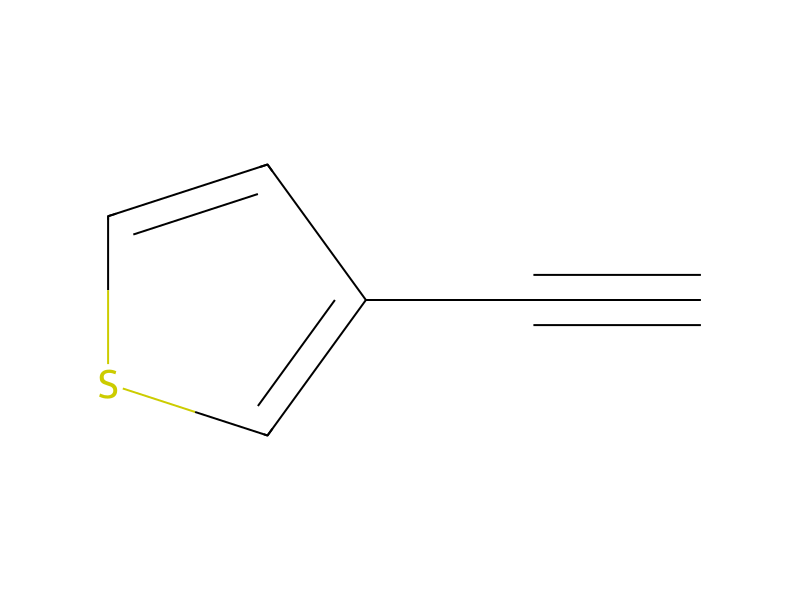
Cl[C:2]1[CH:3]=[N:4][CH:5]=[CH:6][CH:7]=1.[C:8]([C:10]1[CH:14]=[CH:13][S:12][CH:11]=1)#[CH:9].C([O-])([O-])=O.[Cs+].[Cs+].O>C1(P(C2CCCCC2)C2C=CC=CC=2C2C(C(C)C)=CC(S([O-])(=O)=O)=CC=2C(C)C)CCCCC1.[Na+].C(#N)C>[S:12]1[CH:13]=[CH:14][C:10]([C:8]#[C:9][C:2]2[CH:3]=[N:4][CH:5]=[CH:6][CH:7]=2)=[CH:11]1Participants
Reactant 4



Product 1

Reagents, catalysts & solvents 2


Procedure
The general procedure described in Example 27 was used with 3-chloropyridine (0.050 mL, 0.50 mmol), 3-ethynylthiophene (0.074 mL, 0.75 mmol), PdCl2(CH3CN)2 (3.2 mg, 0.0125 mmol, 1.25 mol %), sodium 2′-(dicyclohexyl-phosphanyl)-2,6-diisopropyl-biphenyl-4-sulfonate (20.0 mg, 0.0375 mmol, 3.75 mol %), Cs2CO3 (650 mg, 2.00 mmol), water (1.0 mL), acetonitrile (1.5 mL), 10 h, 100° C. The product was isolated as a white solid (86 mg, 93%). Mp=62° C. (lit. 65.5-64.0° C.). 1H NMR (400 MHz, CDCl3) δ: 8.75 (d, 1H, J=1.6 Hz), 8.54 (dd, 1H, J=2.0 Hz, 5.2 Hz), 7.79 (dt, 1H, J=8.0 Hz, 2.0 Hz), 7.57 (dd, 1H, J=2.8 Hz, 1.2 Hz), 7.32 (dd, 1H, J=5.2 Hz, 2.8 Hz), 7.27 (qd, 1H, J=0.8 Hz, 4.8 Hz, 3.2 Hz), 7.21 (dd, 1H, J=1.2 Hz, 5.2 Hz). 13C NMR (125 MHz, CDCl3) δ: 152.4, 148.7, 138.5, 129.9, 129.6, 125.9, 123.2, 121.8, 120.6, 87.9, 85.7.
Sources & evidence
- ORD record
- ord-8430050ae0544e9f8aced295fa34526c
- Source dataset
- uspto-grants-2009_07
- Patent number
- US07560596B2
Linked notes
Loading…