1,3-Propanediamine → (3-Aminopropyl)(5-nitro(2-pyridyl))amine
Reaction equation

Cl[C:2]1[CH:7]=[CH:6][C:5]([N+:8]([O-:10])=[O:9])=[CH:4][N:3]=1.[NH2:11][CH2:12][CH2:13][CH2:14][NH2:15]>C(#N)C>[NH2:11][CH2:12][CH2:13][CH2:14][NH:15][C:2]1[CH:7]=[CH:6][C:5]([N+:8]([O-:10])=[O:9])=[CH:4][N:3]=1Participants
4
Reactant 2
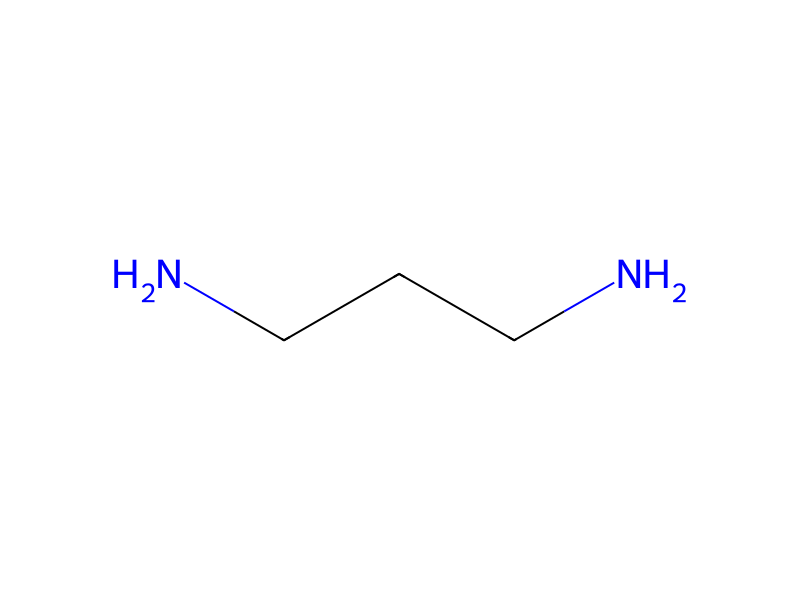

Product 1

Reagents, catalysts & solvents 1

Procedure
A solution of 2-chloro-5-nitropyridine (3.16 g, 20 mmol) in dry acetonitrile (40 ml) was added dropwise to a solution of 1,3-diaminopropane (5.0 ml) in acetonitrile (20 ml) at room temperature. After 7.5 hour, a yellow solid precipitated in the reaction mixture. The solvent was removed in vacuo and the residue was partitioned between 2.5 M aqueous sodium hydroxide and dichloromethane. The layers were separated and the aqueous portion was extracted 3× with dichloromethane. The combined organic layers were back-extracted with a saturated sodium chloride solution, then dried and concentrated in vacuo using a Buchi rotary evaporator Model R-124 to give (3-aminopropyl)(5-nitro(2-pyridyl))amine as a yellow solid (2.55 g). The amine (1.14 g, 6 mmol) was shaken with benzotriazole carboxamidinium 4-methylbenzenesulfonate (2.0 g, 6 mmol) and diisopropylethyl amine (DIEA) (1.05 ml, 6 mmol) in acetonitrile (10 ml) at room temperature over two days. Dilution with ether gave the amino-{3-[(5-nitro(2-pyridyl))amino]propyl}carboxamidinium 4-methylbenzenesulfonate as a solid.