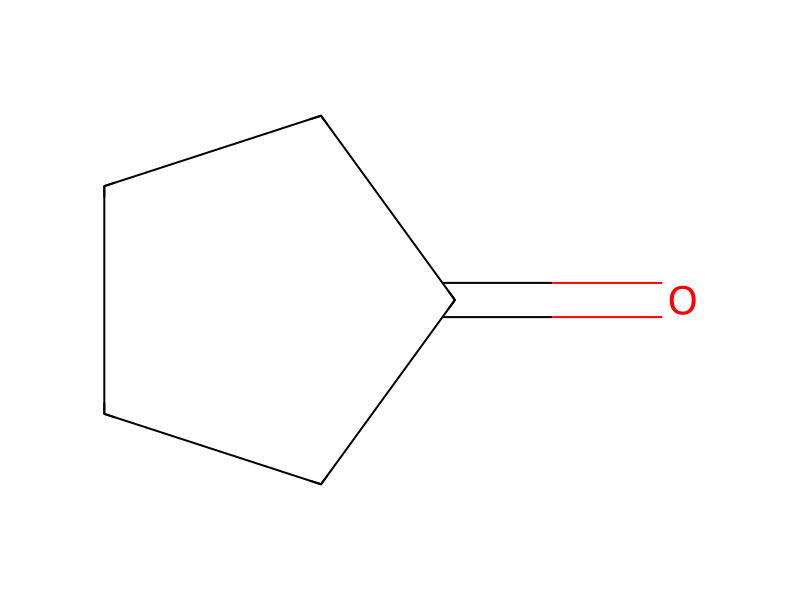
Into a 2-litter four-neck flask fitted with a thermometer, a reflux condenser and a stirrer were added sodium hydroxide (3.2 g) and water (300 ml). Then, a mixture of heptanal (114 g) and cyclopentanone (152 g) was added dropwise thereto under stirring at 0-5° C. over a period of 2 hours. After the addition, the reaction mixture was stirred at room temperature for 1 hour to complete the reaction. Hexane (150 ml) was added to the reaction mixture and the layers were separated from each other. The resulting organic layer was washed with an aqueous solution (200 ml) of acetic acid (1 g) and separated. Then, the resulting organic layer was washed with saturated brine and separated. The organic layer was evaporated on a rotary evaporator under reduced pressure to recover hexane and unreacted cyclopentanone, whereby a product (202 g) was obtained. The product was distilled using a Claisen distillation apparatus to obtain 154 g of 2-(1-hydroxyheptyl)cyclopentanone (boiling point: 112-114° C./666 Pa; GC purity: 92%). The remaining 8% was 2-heptylidenecyclopentanone which is a dehydration product.