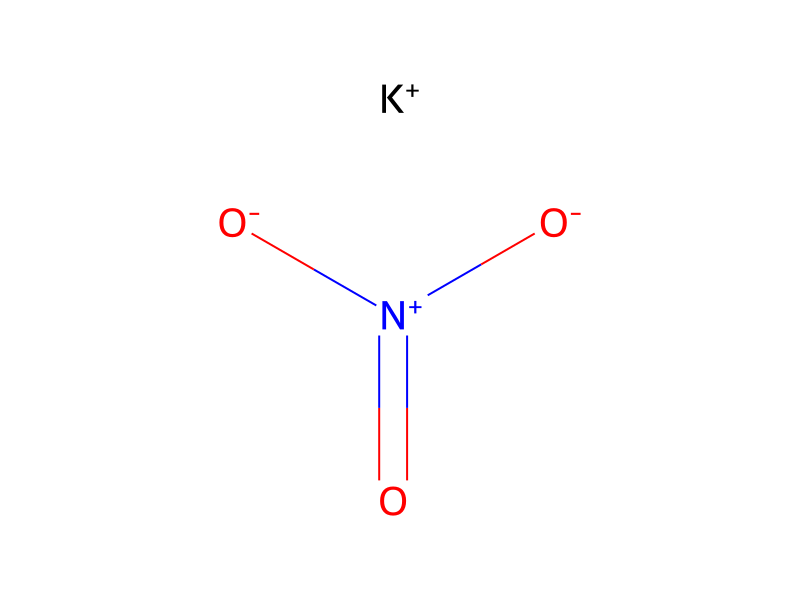
Potassium Nitrate → 2-[(2-Chloro-4-fluoro-5-nitrophenyl)methyl]-4,4-dimethyl-3-isoxazolidinone
HRID 231442
Reaction equation

[Cl:1][C:2]1[CH:7]=[C:6]([F:8])[CH:5]=[CH:4][C:3]=1[CH2:9][N:10]1[C:14](=[O:15])[C:13]([CH3:17])([CH3:16])[CH2:12][O:11]1.[N+:18]([O-])([O-:20])=[O:19].[K+]>S(=O)(=O)(O)O>[Cl:1][C:2]1[CH:7]=[C:6]([F:8])[C:5]([N+:18]([O-:20])=[O:19])=[CH:4][C:3]=1[CH2:9][N:10]1[C:14](=[O:15])[C:13]([CH3:17])([CH3:16])[CH2:12][O:11]1Participants
4



Procedure
By the method of Example 3, Step A, 20 g (0.078 mole) of 2-[(2-chloro-4-fluorophenyl)methyl]-4,4-dimethyl-3-isoxazolidinone, 7.8 g (0.78 mole) of potassium nitrate, and 100 ml of concentrated sulfuric acid were reacted, yielding 12 g of 2-[(2-chloro-4-fluoro-5-nitrophenyl)methyl]-4,4-dimethyl-3-isoxazolidinone as a light yellow solid. Passage through a column of silica gel was omitted since the product was crystalline. Purification was accomplished by recrystallization from ethyl acetate/hexane. This reaction was repeated, and the products were combined.