Reaction equation
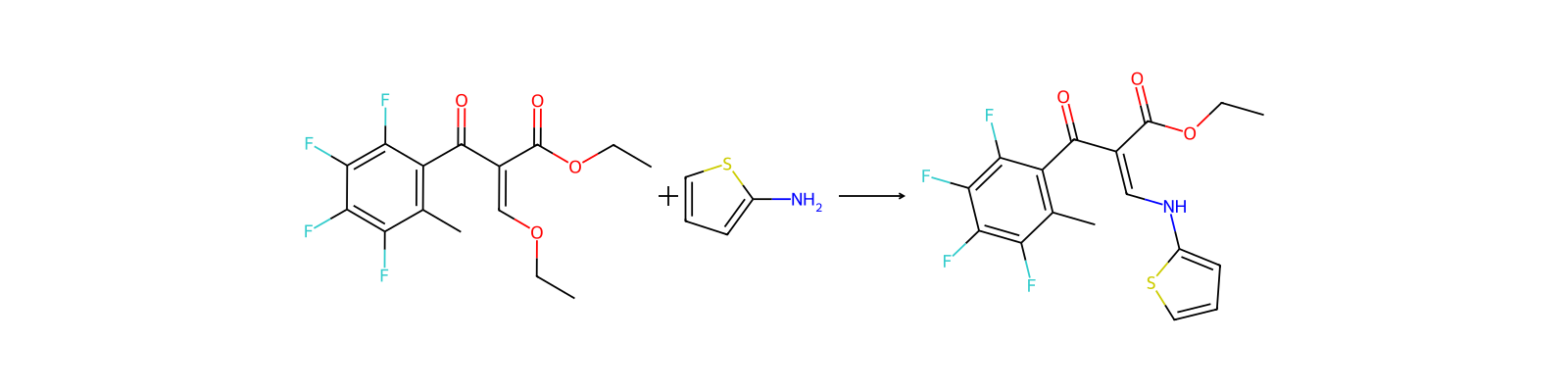
[CH3:1][C:2]1[C:19]([F:20])=[C:18]([F:21])[C:17]([F:22])=[C:16]([F:23])[C:3]=1[C:4]([C:6](=[CH:12]OCC)[C:7]([O:9][CH2:10][CH3:11])=[O:8])=[O:5].[NH2:24][C:25]1[S:26][CH:27]=[CH:28][CH:29]=1>>[CH3:1][C:2]1[C:19]([F:20])=[C:18]([F:21])[C:17]([F:22])=[C:16]([F:23])[C:3]=1[C:4]([C:6](=[CH:12][NH:24][C:25]1[S:26][CH:27]=[CH:28][CH:29]=1)[C:7]([O:9][CH2:10][CH3:11])=[O:8])=[O:5]Participants
3


Procedure
Employing ethyl 2-(2-methyl-3,4,5,6-tetrafluorobenzoyl)3-ethoxyacrylate (5.0 g)and 2-aminothiophene (2.22 g), the procedure of Reference Example 21 is repeated to give ethyl 2-(2-methyl-3,4,5,6-tetrafluorobenzoyl)-3-(2-thienyl)aminoacrylate, which is then treated with 60% sodium hydride as in Reference Example 22 to give ethyl 1-(2-thienyl)-5-methyl-6,7,8-trifluoro-1,4-dihydro-4-oxoquinoline-3-carboxylate (1.05 g), as white powder (recrystallized from ethyl acetate - n-hexane), m.p. 198°-200° C.
Sources & evidence
- ORD record
- ord-64696ba11ba74363a9412e92ee5151b6
- Source dataset
- uspto-grants-1997_01
- Patent number
- US05591744
Linked notes
Loading…