Reaction equation

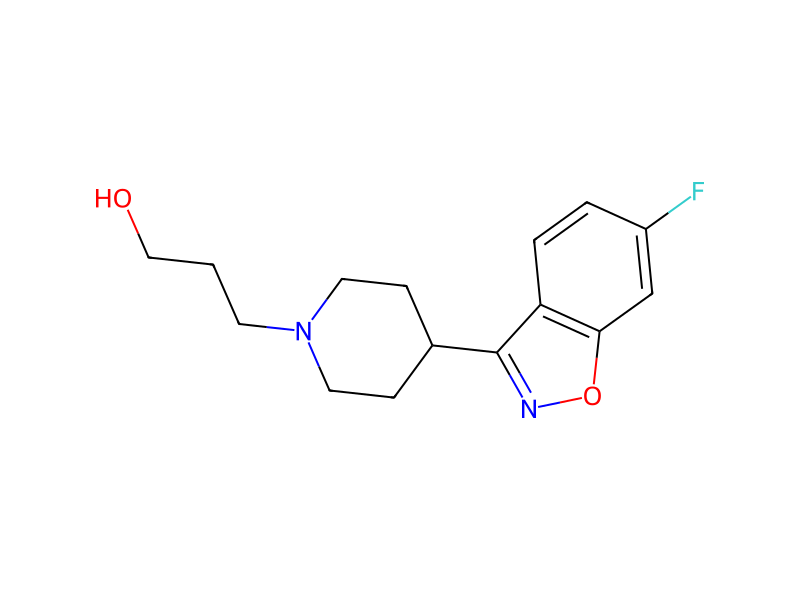
[F:1][C:2]1[CH:16]=[CH:15][C:5]2[C:6]([CH:9]3[CH2:14][CH2:13][NH:12][CH2:11][CH2:10]3)=[N:7][O:8][C:4]=2[CH:3]=1.C([O-])([O-])=O.[K+].[K+].Br[CH2:24][CH2:25][CH2:26][OH:27].C(#N)C>O>[F:1][C:2]1[CH:16]=[CH:15][C:5]2[C:6]([CH:9]3[CH2:10][CH2:11][N:12]([CH2:24][CH2:25][CH2:26][OH:27])[CH2:13][CH2:14]3)=[N:7][O:8][C:4]=2[CH:3]=1Participants
6





Procedure
A stirred mixture of 6-fluoro-3-(4-piperidinyl)-1,2-benzisoxazole (10.0 g, 45 mmol), K2CO3 (10.0 g), 3-bromo-1-propanol (7.3 g, 46 mmol) and acetonitrile (200 ml) was refluxed for 3 hours. The reaction was poured into H2O and 7.1 g of a beige solid was collected. The filtrate was extracted with dichloromethane, and after concentration an additional 6.7 g of crude solid was harvested. The solids were combined and triturated with refluxing ethyl acetate to afford 8.0 g of 6-fluoro-3-[1-(3-hydroxypropyl)-4-piperidinyl]-1,2-benzisoxazole as an off-white solid. A sample (4.0 g) was recrystallized from ethanol-water (with charcoal treatment) to yield 2.4 g (40%) of the alcohol as a white solid, m.p.=140°-142° C.
Workup
- temperaturewas refluxed for 3 hours
- customwas collected
- extractionThe filtrate was extracted with dichloromethane
- concentrationafter concentration an additional 6.7 g of crude solid
- customtriturated with refluxing ethyl acetate
Sources & evidence
- ORD record
- ord-2f6987c60b1845ed80722d788d425207
- Source dataset
- uspto-grants-1997_01
- Patent number
- US05591745
Linked notes
Loading…