Reaction equation

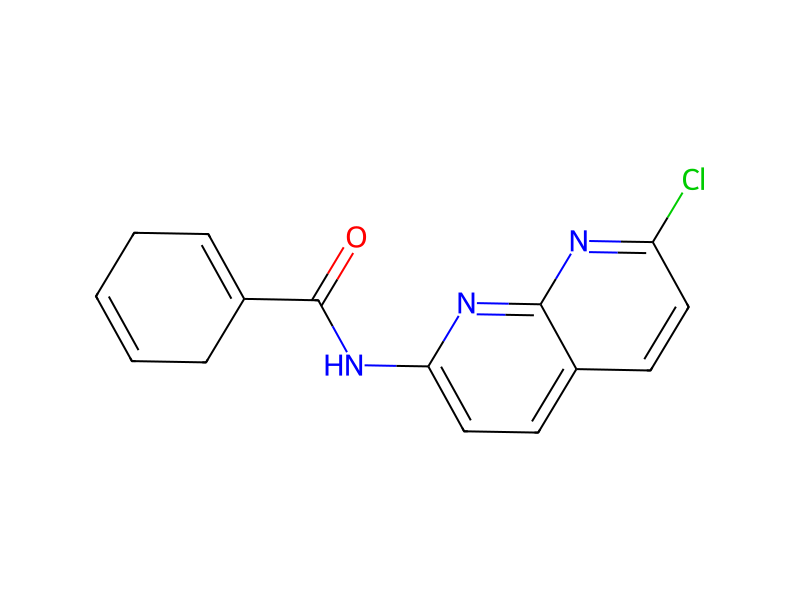
[C:1]1([C:7]([OH:9])=O)[CH2:6][CH:5]=[CH:4][CH2:3][CH:2]=1.[NH2:10][C:11]1[CH:20]=[CH:19][C:18]2[C:13](=[N:14][C:15]([Cl:21])=[CH:16][CH:17]=2)[N:12]=1.C(O)C>O>[Cl:21][C:15]1[N:14]=[C:13]2[C:18]([CH:19]=[CH:20][C:11]([NH:10][C:7]([C:1]3[CH2:6][CH:5]=[CH:4][CH2:3][CH:2]=3)=[O:9])=[N:12]2)=[CH:17][CH:16]=1Participants
5




Conditions
- Temperature
- 4 °C
Procedure
The procedure is similar to that described in Example 1, but starting with 1,4-cyclohexadiene-1-carboxylic acid (6.2 g), N,N'-carbonyldiimidazole (8 g) and 2-amino-7-chloro-1,8-naphthyridine (8 g). The product produced by precipitation in water (11 g; m.p. 205° C.) is dissolved in boiling ethanol (250 cc). After 2 hours' cooling at 4° C., the crystallised solid is separated by filtration, washed with ethanol (3×15 cc) and dried at 40° C. under reduced pressure (0.067 kPa). N-(7Chloro-1,8-naphthyridin-2-yl)-1,4-cyclohexadiene-1-carboxamide (4.2 g) is produced, m.p. 210° C.
Workup
- dissolutionis dissolved
- customthe crystallised solid is separated by filtration
- washwashed with ethanol (3×15 cc)
- customdried at 40° C. under reduced pressure (0.067 kPa)
Sources & evidence
- ORD record
- ord-67f63937ad5640b7979af9cf1aff7358
- Source dataset
- uspto-grants-1987_02
- Patent number
- US04642308
Linked notes
Loading…