Reaction equation

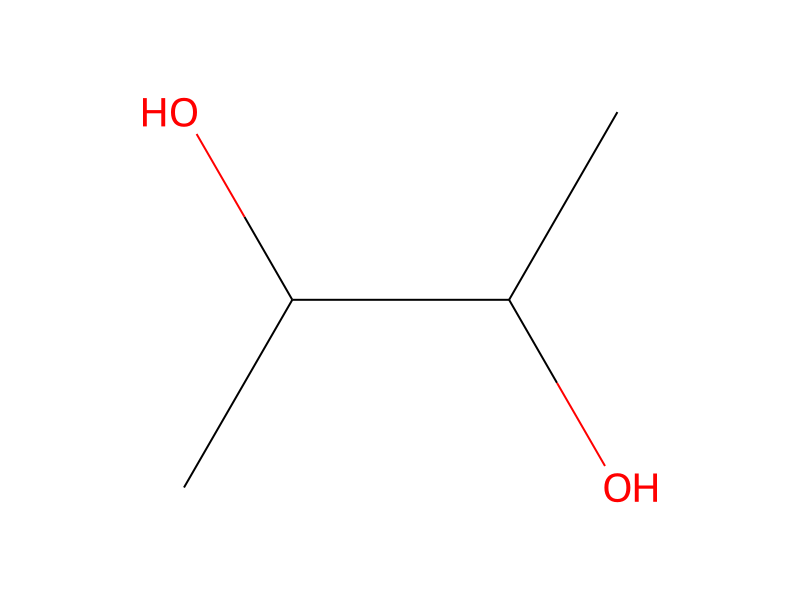
[CH3:1][CH:2]([OH:6])[CH:3]([OH:5])[CH3:4]>C(O)(=O)C>[C:3]([O:5][CH:3]([CH:2]([O:6][C:2](=[O:6])[CH3:1])[CH3:1])[CH3:4])(=[O:5])[CH3:4]Participants
Reactant 1
Product 1

Reagents, catalysts & solvents 1

Procedure
As a by-product in the 1,3-propanediol fermentation, 2,3-butanediol also is an important raw material in chemical industry. It is a colorless and flavorless liquid, and may be used as fuels, and used to prepare polymers, inks, perfumes, antifreezers, fumigants, humidizers, softening agent, plasticizer, explosives, chiral vehicles for pharmaceuticals and the like. Also, 2,3-butanediol may serve as a very valuable raw material in chemical industry to synthesize other chemicals, for example, dehydrating 2,3-butanediol to form methyl ethyl ketone with quite extensive applications, and further dehydrating to form 1,3-butadiene. 2,3-Butanediol can be polymerized to produce styrene via a Diels-Alder reaction. 2,3-Butanediol and methyl ethyl ketone may condense and then subject to a hydrogenating reaction to form octane, which can be used to produce high quality materials for flight. 2,3-Butanediol reacts with acetic acid to form 2,3-butanediol diacetate, which can be added to butters to improve flavor. Generally, 2,3-butanediol, however, is not be separated and purified as a product due to its low yields in the 1,3-propanediol fermentation.
Workup
- customto produce high quality materials for flight
Sources & evidence
- ORD record
- ord-dd387d1d4c0b4d50889e01780bd0a137
- Source dataset
- uspto-grants-2011_06
- Patent number
- US07968319B2
Linked notes
Loading…