HomeMCPWorkbenchSkills
HomeWorkbenchNotificationsMe
llms.txt · MCP GuidePrivacy Policy · Terms of Service · Supportv1.8.0
  1. Home
  2. /Reaction

1,4-Dioxane → Ethyl 5-[1-[(2S)-2-methoxypropyl]-3-methyl-2-oxo-imidazo[4,5-c]quinolin-8-yl]pyridine-3-carboxylate

HRID 244598
Notes
Print preview

Reaction equation

HRID 244598 reaction equation
Br[C:2]1[CH:11]=[CH:10][C:9]2[N:8]=[CH:7][C:6]3[N:12]([CH3:21])[C:13](=[O:20])[N:14]([CH2:15][C@@H:16]([O:18][CH3:19])[CH3:17])[C:5]=3[C:4]=2[CH:3]=1.CC1(C)C(C)(C)OB([C:30]2[CH:31]=[C:32]([C:36]([O:38][CH2:39][CH3:40])=[O:37])[CH:33]=[N:34][CH:35]=2)O1.C(OCC)(=O)C.[Na].O1CCOCC1>ClCCl.[Pd](Cl)Cl.C1(P(C2C=CC=CC=2)[C-]2C=CC=C2)C=CC=CC=1.[C-]1(P(C2C=CC=CC=2)C2C=CC=CC=2)C=CC=C1.[Fe+2].O>[CH3:19][O:18][C@@H:16]([CH3:17])[CH2:15][N:14]1[C:5]2[C:4]3[CH:3]=[C:2]([C:30]4[CH:31]=[C:32]([C:36]([O:38][CH2:39][CH3:40])=[O:37])[CH:33]=[N:34][CH:35]=4)[CH:11]=[CH:10][C:9]=3[N:8]=[CH:7][C:6]=2[N:12]([CH3:21])[C:13]1=[O:20]
ParticipantsConditionsProcedureWorkupSources & evidenceReaction notes

Participants

7

Reactant 4

HCID 312751,4-DioxaneHCID 3816953Ethyl 5-(tetramethyl-1,3,2-dioxaborolan-2-yl)pyridine-3-carboxylateHCID 681081048-bromo-1-[(2S)-2-methoxypropyl]-3-methyl-imidazo[4,5-c]quinolin-2-oneHCID 86668134Sodium ethyl acetate

Product 1

HCID 68107958Ethyl 5-[1-[(2S)-2-methoxypropyl]-3-methyl-2-oxo-imidazo[4,5-c]quinolin-8-yl]pyridine-3-carboxylate
Yield 80%

Reagents, catalysts & solvents 2

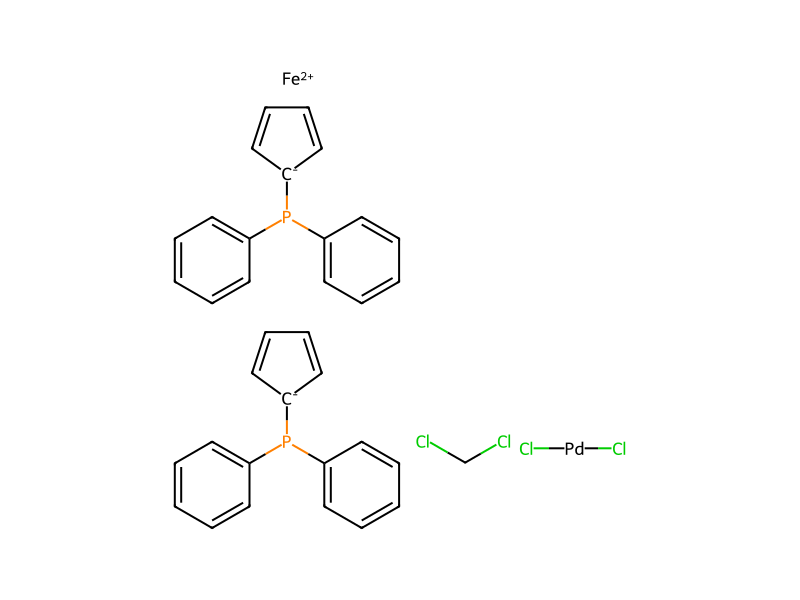
HCID 178418807HCID 178418807, compoundCatalystHCID 962WaterSolvent

Conditions

Temperature
85 °C

Procedure

To a three-necked flask containing 8-bromo-1-[(2S)-2-methoxypropyl]-3-methyl-imidazo[4,5-c]quinolin-2-one (35 g, 100 mmol), ethyl 5-(4,4,5,5-tetramethyl-1,3,2-dioxaborolan-2-yl)pyridine-3-carboxylate (29.1 g, 105 mmol), sodium ethyl acetate (28.7 g, 350 mmol), 1,1′-bis(diphenylphosphino)ferrocene-palladium(II)dichloride dichloromethane (0.817 g, 1.0 mmol) add 1,4-dioxane (200 mL) and water (200 mL) under N2. Then heat the reaction mixture to 85° C. and continue stirring for 10 hours. Cool the reaction mixture to room temperature. Filter the mixture with Kieselguhr® Silica-Thiol to remove the catalyst. Add water (400 mL) drop wise and solid precipitates. Filter the mixture and wash the solid with water (400 mL). Stir the solid in ethyl acetate (70 mL) at room temperature for one hour; filter, wash with ethyl acetate (70 mL), and dry under vacuum below 65° C. to give the title compound (33.6 g, 80%). 1H NMR (CDCl3, 400 MHz) δ 9.25 (d, 1H, J=2 Hz), 9.15 (d, 1H, J=2.4 Hz), 8.75 (s, 1H), 8.73 (d, 1H, J=1.6 Hz), 8.65 (t, 1H), 8.24 (d, 1H, J=8.8 Hz), 7.89 (dt, 1H, J=8.8, 1.6 Hz), 4.47 (q, 2H), 4.38 (m, 2H), 3.90 (m, 1H), 3.64 (s, 3H), 3.26 (s, 3H), 1.45 (t, 3H), 1.37 (d, 3H, J=6 Hz).

Workup

  1. temperatureCool the reaction mixture to room temperature
  2. filtrationFilter the mixture with Kieselguhr® Silica-Thiol
  3. customto remove the catalyst
  4. customAdd water (400 mL) drop wise and solid precipitates
  5. filtrationFilter the mixture
  6. washwash the solid with water (400 mL)
  7. stirringStir the solid in ethyl acetate (70 mL) at room temperature for one hour
  8. filtrationfilter
  9. washwash with ethyl acetate (70 mL)
  10. customdry under vacuum below 65° C.

Sources & evidence

ORD record
ord-9d9bd455acf54bf694651401e09699d3
Source dataset
uspto-grants-2014_02
DOI
10.6084/m9.figshare.5104873.v1
Patent number
US08658668B2

Reaction notes

Loading…

On this pageParticipantsConditionsProcedureWorkupSources & evidenceReaction notes