Reaction equation
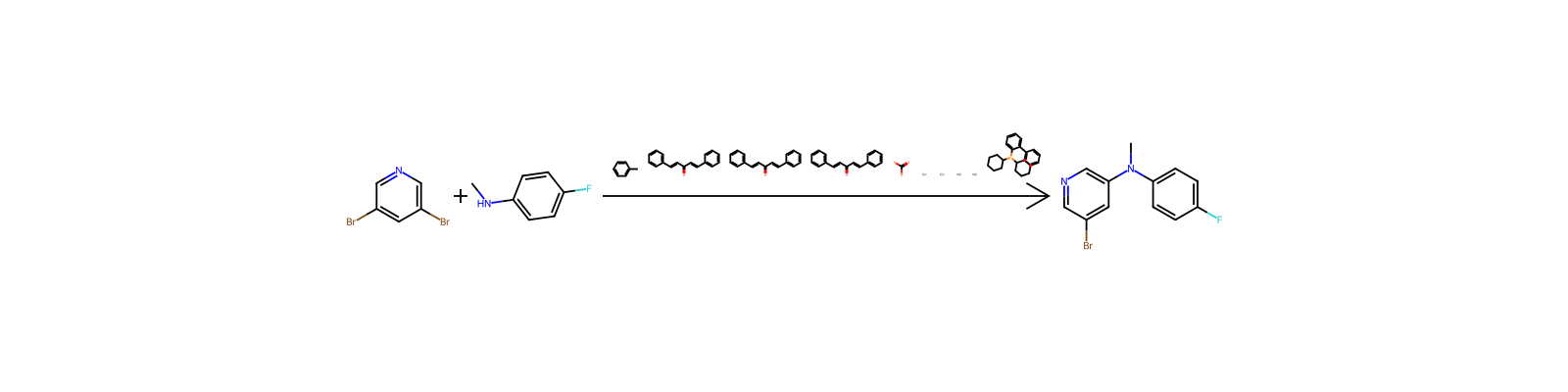
Brc1cncc(Br)c1.CNc1ccc(F)cc1>Cc1ccccc1.O=C(/C=C/c1ccccc1)/C=C/c1ccccc1.O=C(/C=C/c1ccccc1)/C=C/c1ccccc1.O=C(/C=C/c1ccccc1)/C=C/c1ccccc1.O=C([O-])[O-].[Cs+].[Cs+].[Pd].[Pd].c1ccc(-c2ccccc2P(C2CCCCC2)C2CCCCC2)cc1>CN(c1ccc(F)cc1)c1cncc(Br)c1Participants
7
Reactant 2


Product 1

Reagents, catalysts & solvents 4



Conditions
- Temperature
- 110 °C
Procedure
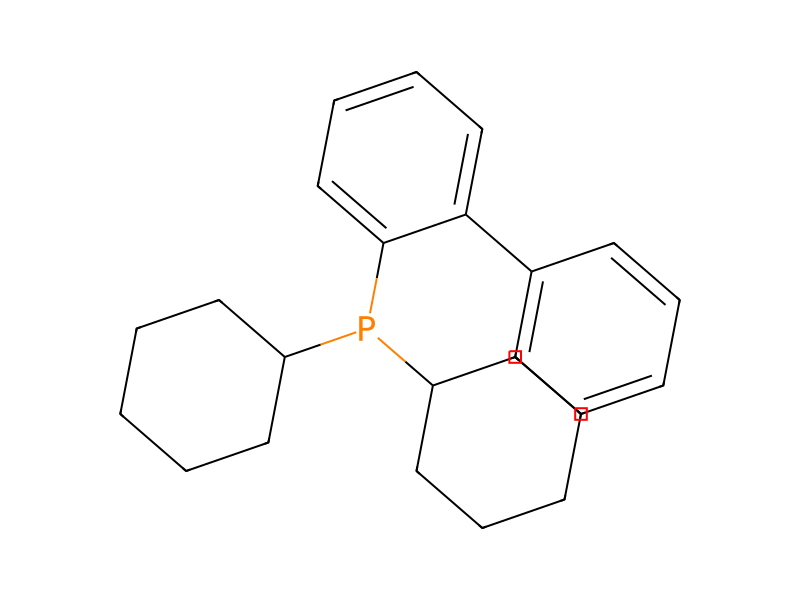
In a 50 mL round-bottomed flask (t=g) was 4-fluoro-N-methylaniline (.05 g, 0.40 mmol), 3,5-dibromopyridine (0.114 g, 0.48 mmol), and Pd2(dba)3 (0.018 g, 0.02 mmol) in toluene (16 mL) ([VOLUME]) to give a purple suspension. biphenyl-2-yldicyclohexylphosphine (0.021 g, 0.06 mmol) and CS2CO3 (0.195 g, 0.60 mmol) were added. After LC/MS indicated no reaction had taken place at room temp, the temperature was gradually rasied to up to 110 degrees. LC/MS indicated that the reaction was not progressing. Reaction was discarded.
Sources & evidence
- ORD record
- ord-d1bfb220e27441fcb5908d58a9e8690c
- Source dataset
- 750 AstraZeneca ELN dataset
- Original link
- View source
Linked notes
Loading…