Reaction equation

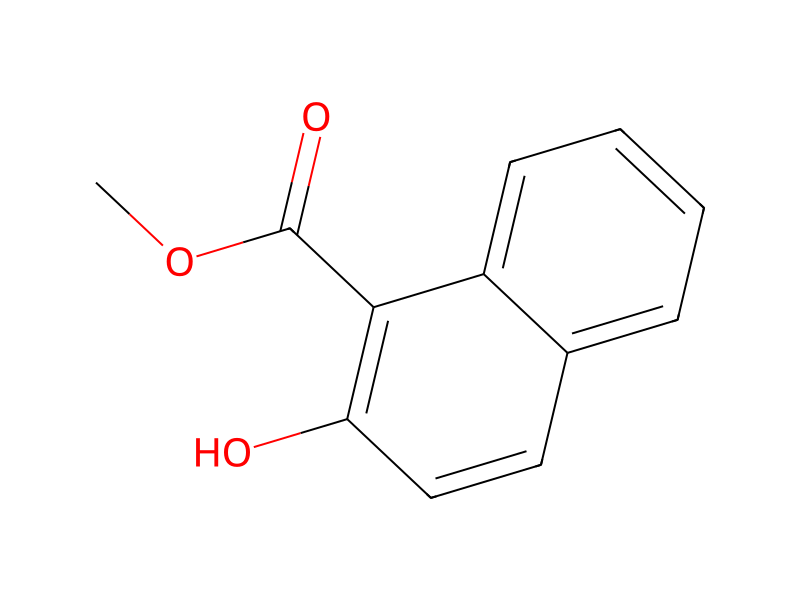
[OH:1][C:2]1[CH:11]=[CH:10][C:9]2[C:4](=[CH:5][CH:6]=[CH:7][CH:8]=2)[C:3]=1[C:12]([O:14][CH3:15])=[O:13].[H][H]>[Pd].C(O)(=O)C>[OH:1][C:2]1[CH:11]=[CH:10][C:9]2[CH2:8][CH2:7][CH2:6][CH2:5][C:4]=2[C:3]=1[C:12]([O:14][CH3:15])=[O:13]Participants
5




Procedure
In 2.5 l. of glacial acetic acid is dissolved 417 g. of methyl 2-hydroxy-1-naphthoate, and with the addition of 150 g. of 5% palladium-on-carbon, reduction is carried out at a temperature of 60° to 80° C with hydrogen introduced at a pressure of 100kg./cm2. In 3 hours, approximately 2 moles of hydrogen is absorbed. The reaction mixture is filtered and the filtrate is concentrated under reduced pressure. The residue is then subjected to distillation under reduced pressure and the fraction boiling at 123° -125° C (0.6 mmHg) is recovered to obtain methyl 2-hydroxy-5,6,7,8-tetrahydro-1-naphthoate as a colorless oil. The oil solidifies on standing in the cold.
Workup
- additionintroduced at a pressure of 100kg
- filtrationThe reaction mixture is filtered
- concentrationthe filtrate is concentrated under reduced pressure
- distillationThe residue is then subjected to distillation under reduced pressure
- customthe fraction boiling at 123° -125° C (0.6 mmHg) is recovered
Sources & evidence
- ORD record
- ord-2126f8ab992c4dcc9337b56ee47aa1d9
- Source dataset
- uspto-grants-1977_07
- Patent number
- US04035512
Linked notes
Loading…