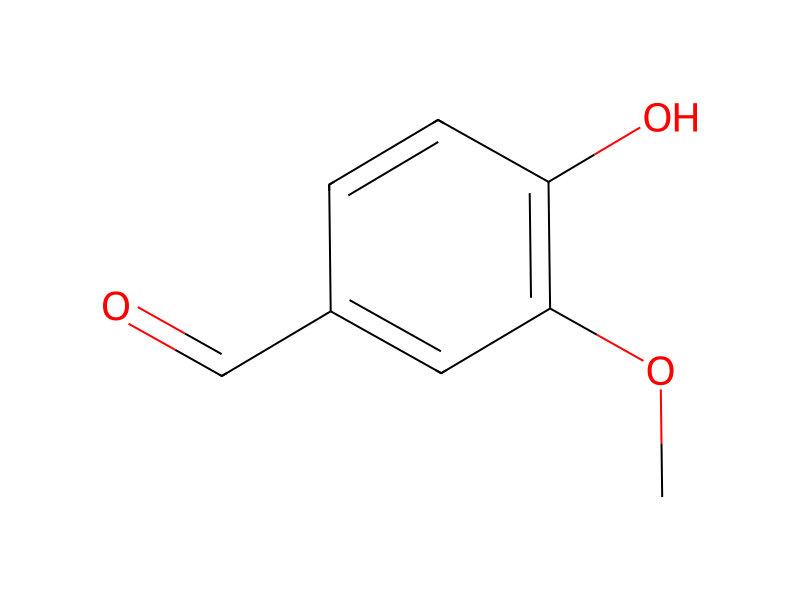
Carbon Dioxide → Vanillin
Reaction equation

[OH:1][C:2]1[CH:7]=[CH:6][C:5]([CH:8]([OH:12])C(O)=O)=[CH:4][C:3]=1[O:13][CH3:14].C(=O)=O>O>[OH:1][C:2]1[CH:7]=[CH:6][C:5]([CH:8]=[O:12])=[CH:4][C:3]=1[O:13][CH3:14]Participants
4
Reactant 2


Product 1
Reagents, catalysts & solvents 1

Procedure
10 g of 4-hydroxy-3-methoxyphenylglycolic acid (molecular weight 198) are dissolved in 100 g of water, and 82 g of an aqueous 20% FeCl3 -solution are added over a period of 20 to 30 minutes at 75° to 80° C., thus initiating a vigorous evolution of carbon dioxide which abates after another 30 minutes. The reaction takes place at a pH-value of from 2 to 0.8. Most of the 4-hydroxy-3-methoxy benzaldehyde formed completely crystallises out of the acid oxidation solution on cooling. The 4-hydroxy-3-methoxybenzaldehyde can be completely extracted from the oxidation solution with benzene or toluene. The extract is washed with a little water, after which the solvent is distilled off until the 4-hydroxy-3-methoxybenzaldehyde can be precipitated from the mother liquor in crystalline form with cyclohexane or with light petrol.