Reaction equation
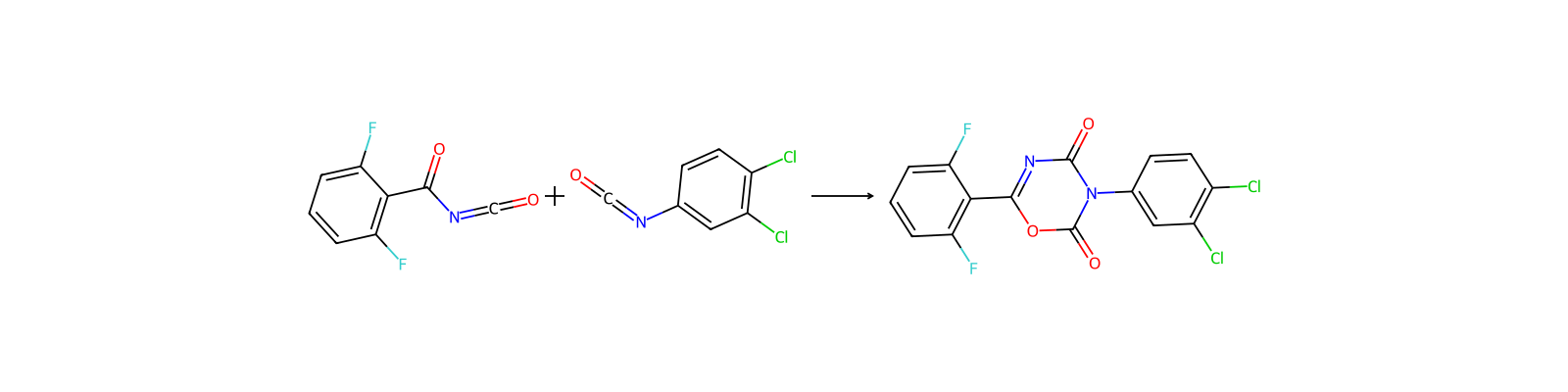
[F:1][C:2]1[CH:12]=[CH:11][CH:10]=[C:9]([F:13])[C:3]=1[C:4]([N:6]=[C:7]=[O:8])=[O:5].[Cl:14][C:15]1[CH:16]=[C:17]([N:22]=[C:23]=[O:24])[CH:18]=[CH:19][C:20]=1[Cl:21]>>[Cl:14][C:15]1[CH:16]=[C:17]([N:22]2[C:7](=[O:8])[N:6]=[C:4]([C:3]3[C:2]([F:1])=[CH:12][CH:11]=[CH:10][C:9]=3[F:13])[O:5][C:23]2=[O:24])[CH:18]=[CH:19][C:20]=1[Cl:21]Participants
3


Conditions
- Temperature
- 120 °C
Procedure
A mixture of freshly prepared 2,6-difluorobenzoyl isocyanate (1.85 g) and 3,4-dichlorophenyl isocyanate (1.89 g) is heated at 120° C. for a period of 16 hours, and then cooled. Recrystallisation of the solid which was obtained from ethyl acetate yielded 3-(3,4-dichlorophenyl)-6-(2,6-difluorophenyl)-3,4-dihydro-2H-1,3,5-oxadiazin-2,4-dione, white crystals, m.p. 196°-197° C.
Workup
- temperaturecooled
- customRecrystallisation of the solid which
- customwas obtained from ethyl acetate
Sources & evidence
- ORD record
- ord-3d3e27c075c14994bdba283accd4a3d8
- Source dataset
- uspto-grants-1979_04
- Patent number
- US04150158
Linked notes
Loading…