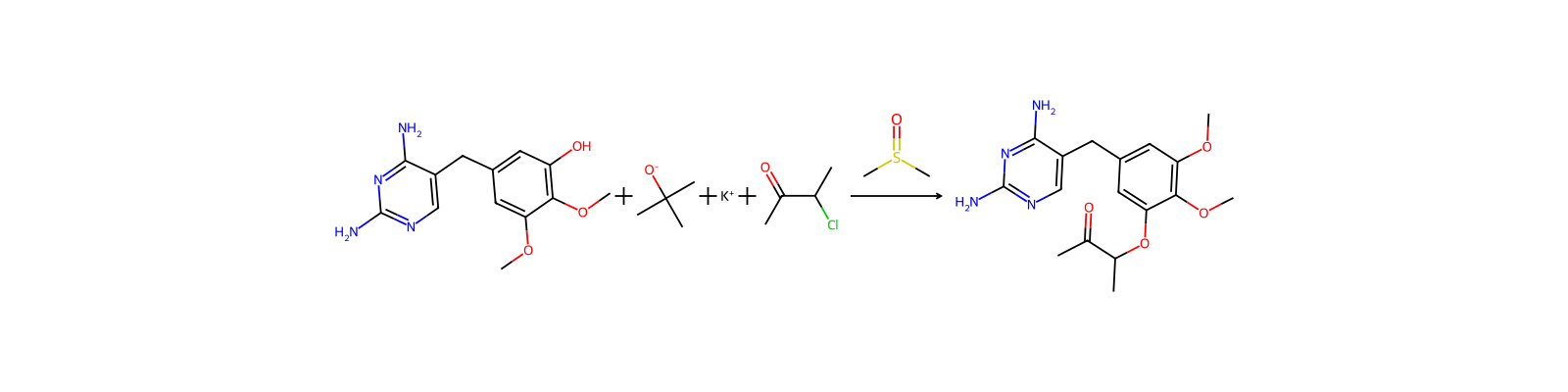
To a solution of 2.76 g (0.01 mole) of 2,4-diamino-5-(3-hydroxy-4,5-dimethoxybenzyl)pyrimidine (D. E. Schwartz, W. Vetter, and G. Englert, Arzneim.-Forsch. (Drug Res.) 1970, 20, 1867; G. Rey-Bellet and R. Reiner, Helv. Chim. Acta 1970, 53, 945) in 40 mL of dry dimethyl sulfoxide was added 1.12 g (0.01 mole) of potassium t-butoxide. To the resulting suspension was added in one portion 1.16 g (0.0109 mole) of 3-chloro-2-butanone. The mixture was stirred at room temperature for 1 hour. The solvent was removed under vacuum and the residue was partitioned between 100 mL of methylene chloride and 100 mL of 0.1N sodium hydroxide. The organic layer was separated and the aqueous layer was extracted with an additional 100 mL of methylene chloride. The organic layers were combined, washed with 100 mL of water, dried (MgSO4) and concentrated to give a quantitative yield (3.58 g) of the title compound. Recrystallization from 95% ethanol gave an analytical sample; mp 167.5°-168.5°. Anal. Calc'd for C17H22N4O4 : C, 58.95; H, 6.40; N, 16.17. Found: C, 58.77; H, 6.42; N, 16.13.