Water → Caprolactam n-Hexylamine
Reaction equation
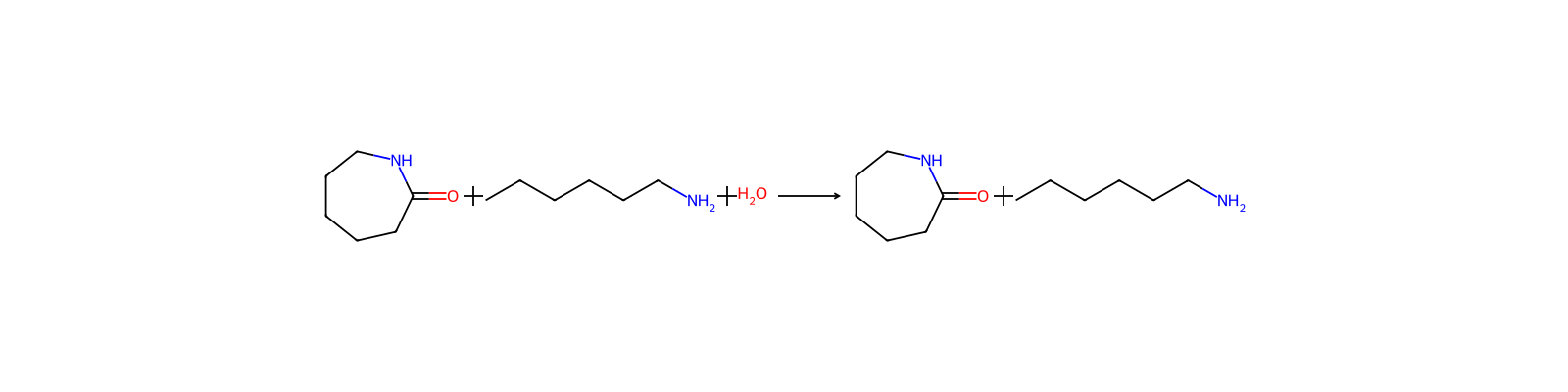
[C:1]1(=[O:8])[NH:7][CH2:6][CH2:5][CH2:4][CH2:3][CH2:2]1.[CH2:9]([NH2:15])[CH2:10][CH2:11][CH2:12][CH2:13][CH3:14].O>>[C:1]1(=[O:8])[NH:7][CH2:6][CH2:5][CH2:4][CH2:3][CH2:2]1.[CH2:9]([NH2:15])[CH2:10][CH2:11][CH2:12][CH2:13][CH3:14]Participants
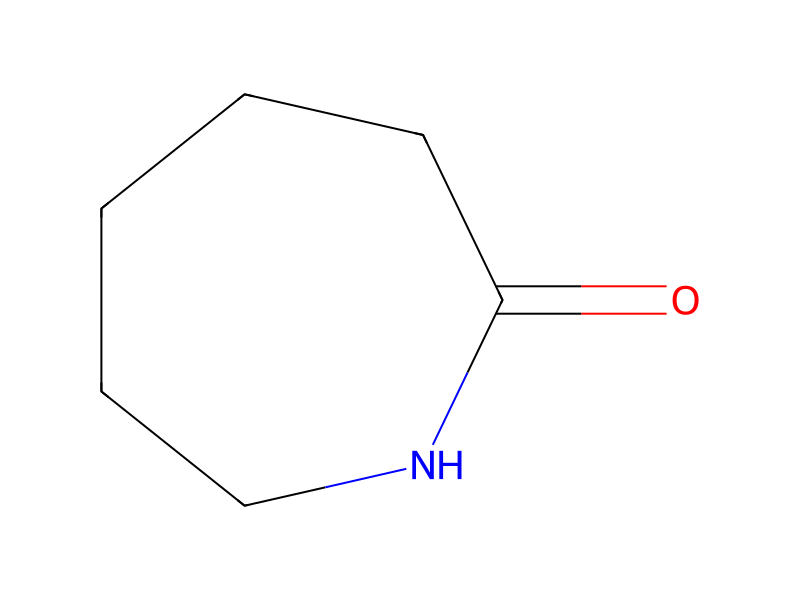
4



Conditions
- Temperature
- 250 °C
Procedure
A 200-ml. pressure reactor was charged with 50 g. (0.442 mole) of ε-caprolactam (CL), 10 g. (0.099 mole) of n-hexylamine (HA) and 0.2 g. (0.011 mole) of water. The reactor was cooled in a dry ice-acetone bath, evacuatively purged twice with nitrogen, evacuated, and heated at 250° C. for 16 hours with the contents under autogenous pressure. The cooled product was a soft white solid. A 45-g. portion was extracted by centrifugation first with about 900 ml. of 1:1 acetone:water and secondly with acetone. The air-dried residue weighed 25.5 g., and could be readily crushed to a fine powder. Analysis showed 865 equivalents of amino end groups per 106 g., corresponding to a degree of polymerization (DP) of about 9. Differential scanning calorimetry (DSC) showed a major melting endotherm at 196°-198° C.