Reaction equation

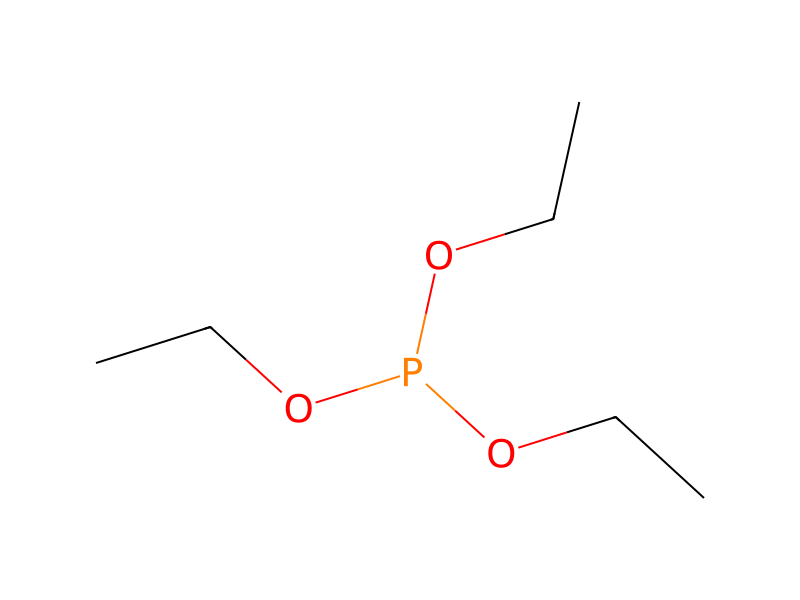
[C:1](Cl)(=[O:8])[C:2]1[CH:7]=[CH:6][CH:5]=[CH:4][CH:3]=1.[P:10]([O:17]CC)([O:14][CH2:15][CH3:16])[O:11][CH2:12][CH3:13].C(Cl)C>>[C:1]([P:10](=[O:17])([O:14][CH2:15][CH3:16])[O:11][CH2:12][CH3:13])(=[O:8])[C:2]1[CH:7]=[CH:6][CH:5]=[CH:4][CH:3]=1Participants



Procedure
To 140.57 grams (1.0 mole) of benzoyl chloride at 90° C. there were added 166.2 grams (1.0 mole) of triethyl phosphite over a period of 1 hour. Ethyl chloride evolution ceased at the end of this period. The unreacted benzoyl chloride and triethyl phosphite were removed by distillation at reduced pressure, terminal conditions being 100° C. and 8 mm. leaving a residue of 236 grams (90% yield) of diethyl benzoylphosphonate which was reacted with diethyl sodium phosphite as in Example 1 to produce tetraethyl phenyl hydroxymethane diphosphonate. This was hydrolyzed and the hydrolysis product purified in the same manner as in Example 1 to produce phenyl hydroxymethane diphosphonic acid as a viscous syrup having an acid number of 822 mg. KOH/mg (Theory is 836 mg. KOH/gm); % P 22.8 (Theory 22.9%).
Workup
- customThe unreacted benzoyl chloride and triethyl phosphite were removed by distillation at reduced pressure, terminal conditions
- custombeing 100° C.
Sources & evidence
- ORD record
- ord-cc3472d463c64788a989fd9842b9a632
- Source dataset
- uspto-grants-1984_04
- Patent number
- US04440646
Linked notes
Loading…