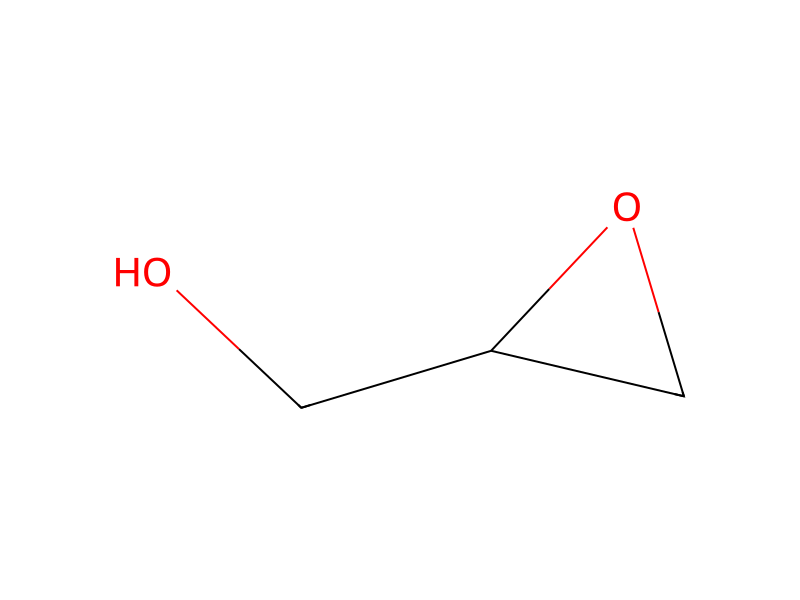
Cl[C:2]1[N:7]=[C:6]([Cl:8])[N:5]=[C:4]([O:9][C:10]2[C:15]([CH3:16])=[CH:14][C:13]([CH3:17])=[CH:12][C:11]=2[CH3:18])[N:3]=1.[O:19]1[CH2:23][CH:20]1[CH2:21][OH:22].[OH-].[Na+]>ClCCl>[Cl:8][C:6]1[N:7]=[C:2]([O:22][CH2:21][CH:20]2[O:19][CH2:23]2)[N:3]=[C:4]([O:9][C:10]2[C:15]([CH3:16])=[CH:14][C:13]([CH3:17])=[CH:12][C:11]=2[CH3:18])[N:5]=1To a mechanically stirred solution of 50 g (0.155 mol) 2,4-dichloro-6-(2,4,6-trimethylphenoxy)-1,3,5-triazine in 170 ml dichloromethane, cooled to 0°.varies.10° C., was added 26.38 g (0.356 mol) 2,3-epoxy-1-propanol in one portion. Aqueous sodium hydroxide (50% solution; 14.26 g) was added to the mixture dropwise with stirring over about 25 minutes maintaining the reaction temperature between 0° and 10° C. and preferably around 0°-5° C. After stirring an additional 30 minutes, the reaction mixture was allowed to warm slowly to room temperature. The dichloromethane layer was washed with distilled water until neutral and dried over magnesium sulfate. The reaction product was found by proton nuclear magnetic resonance to be 2-chloro-4-glycidoxy-6-(2,4,6-trimethylphenoxy)-1,3,5-triazine.
Loading…