HuagongsheHuagongshe Chemistry Print Report · For research reference only
HRID 35294Generated: October 26, 2026
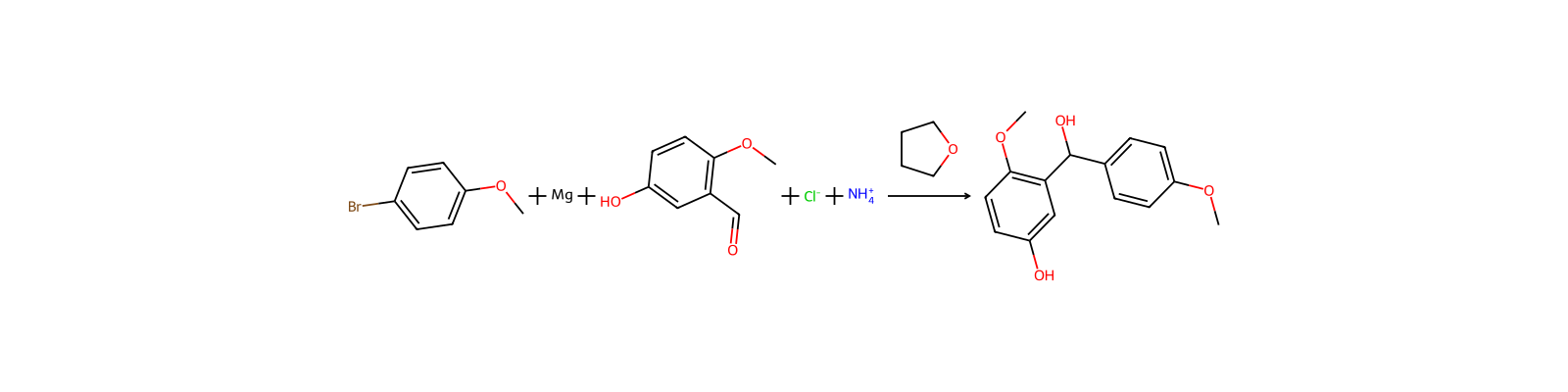
4-Bromoanisole → 1-(5-Hydroxy-2-methoxyphenyl)-1-(4-methoxy-phenyl)-methanol
https://huagongshe.com/reaction/35294
Participants
| Role | Name | HCID | Charge |
|---|
| Reactant | 4-Bromoanisole | HCID 7730 | — |
| Reactant | Ammonium Chloride | HCID 25517 | — |
| Reactant | 5-Hydroxy-2-Methoxybenzaldehyde | HCID 358341 | — |
| Reactant | Magnesium | HCID 5462224 | — |
| Solvent | Tetrahydrofuran | HCID 8028 | — |
| Product | 1-(5-Hydroxy-2-methoxyphenyl)-1-(4-methoxy-phenyl)-methanol | HCID 15023955 | 99.4% |
Reaction Steps
To the Grignard reagent prepared from 4-bromoanisole (286 g) and magnesium turnings (38.5 g) in dry tetrahydrofuran (480 ml) was added, dropwise, with vigorous stirring, a solution of 5-hydroxy-2-methoxybenzaldehyde (100 g) in dry tetrahydrofuran (1 liter). The mixture was heated on a steam bath for 3 hours, cooled and decomposed with saturated ammonium chloride solution. The organic layer was removed and the aqueous extracted with ethyl acetate (twice). The combined organics were washed with water, dried with anhydrous magnesium sulphate and evaporated to dryness. The residue was stirred with water (4 liters), and the buff coloured solid collected and dried to give crude 1-(5-hydroxy-2-methoxyphenyl)-1-(4-methoxy- phenyl)-methanol (170 g, 99%), m.p. 62°-68°. This carbinol (85 g) was dissolved in ethanol (700 ml) and 10% palladium on charcoal (10 g) added. The mixture was hydrogenated in a Parr apparatus at 45° until hydrogen uptake ceased. The mixture was filtered, the filtrate evaporated to dryness and the residue filtered through a column containing silica gel, eluting with dichloromethane, to give 2,4'-dimethoxy-5-hydroxydiphenylmethane (46 g, 58%), m.p. 56°-58° (from petroleum spirit (60°-80°)).
Provenance & Evidence
| DOI | 10.6084/m9.figshare.5104873.v1 |
|---|
| Patent number | US04766121 |
|---|
| Source dataset | uspto-grants-1988_08 |
|---|
| ORD ID | ord-ad1bcaf341ee4060afdc32587a7a75af |
|---|
| Source note | uspto-grants-1988_08 |
|---|