HuagongsheHuagongshe Chemistry Print Report · For research reference only
HRID 362Generated: October 23, 2026
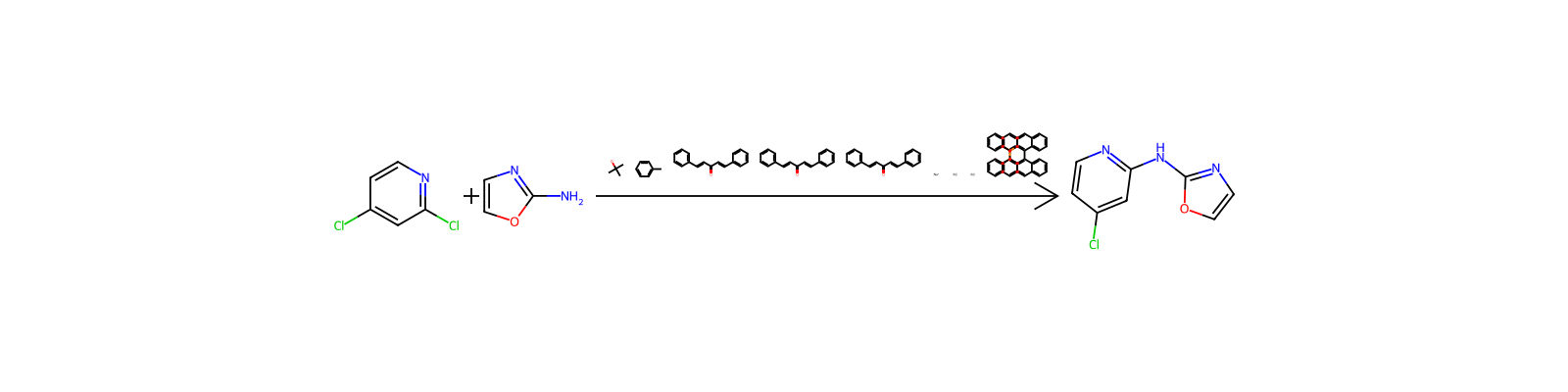
2,4-Dichloropyridine → N-(4-chloro-2-pyridinyl)-1,3-oxazol-2-amine
https://huagongshe.com/en/reaction/362
Participants
| Role | Name | HCID | Charge |
|---|
| Reactant | 2,4-Dichloropyridine | HCID 33515 | — |
| Reactant | 2-Aminooxazole | HCID 558521 | — |
| Reagent | Sodium t-butoxide | HCID 23676156 | — |
| Catalyst | Binap, (A+-)- | HCID 634876 | — |
| Catalyst | Bis(dibenzylideneacetone)palladium | HCID 9811564 | — |
| Solvent | Toluene | HCID 1140 | — |
| Product | N-(4-chloro-2-pyridinyl)-1,3-oxazol-2-amine | HCID 130016260 | 0% |
Reaction Steps
To a vial containing oxazol-2-amine (102 mg, 1.22 mmol), , TRIS(DIBENZYLIDENEACETONE)DIPALLADIUM(0) (9.28 mg, 10.14 µmol), 2,2'-bis(diphenylphosphino)-1,1'-binaphthyl (9.47 mg, 0.02 mmol) and sodium 2-methylpropan-2-olate (136 mg, 1.42 mmol), was added degassed toluene (4 mL) and 2,4-dichloropyridine (0.109 ml, 1.01 mmol) and the reaction mixture was heated to 100 degrees C for 20 h. None of the desired product was observed by LCMS or in crude proton NMR. **It is of note that although the 2,4-dichloropyridine is present in the crude proton NMR, the oxazole-2-amine is not**. It is possible that under the strongly basic reaction conditions that this starting material decomposed. Product not isolated.
Provenance & Evidence
| Source dataset | 750 AstraZeneca ELN dataset |
|---|
| ORD ID | ord-4ba5714524f04061a19a2e24cddcf117 |
|---|
| Source note | 750 AstraZeneca ELN dataset |
|---|