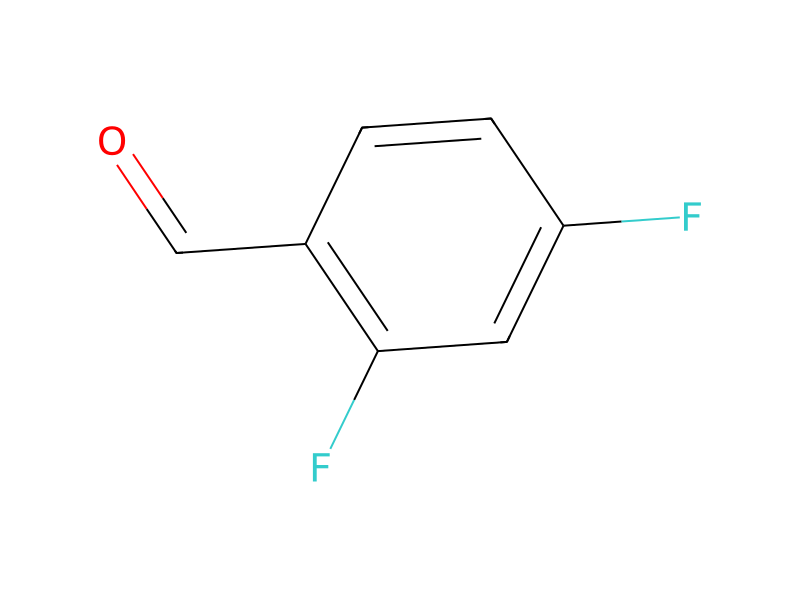
2,4-Difluorobenzaldehyde → 2,4-Difluoro-1-methylbenzene
HRID 365973
Reaction equation

[F:1][C:2]1[CH:9]=[C:8]([F:10])[CH:7]=[CH:6][C:3]=1[CH:4]=O.FC1C=C(F)C=CC=1CO>[Ni]>[F:1][C:2]1[CH:9]=[C:8]([F:10])[CH:7]=[CH:6][C:3]=1[CH3:4]Participants
4
Reactant 2

Product 1

Reagents, catalysts & solvents 1

Procedure
DE-A 2,333,849 discloses that 2,4-difluorobenzaldehyde can be converted into 2,4-difluorobenzyl alcohol in a yield of 68.6% by hydrogenation over Raney nickel. Disadvantages of this process are not only the large amount of catalyst (31 g per mol) and the large amount of a solvent (1100 ml per mole) but also the unsatisfactory yield of 68.6%. These factors result in an unsatisfactory space-time yield. The aldehyde used was obtained here from the difficult-to-obtain 2,4-difluorotoluene by side-chain chlorination and subsequent hydrolysis.
Workup
- customThese factors result in an unsatisfactory space-time
- customyield
Sources & evidence
- ORD record
- ord-7abb27e4324043f09f8c1963b7bffe45
- Source dataset
- uspto-grants-2000_10
- Patent number
- US06127581